
Four New Israeli Outposts Established in Hebron Region
Translated & summarized from i24NEWS Arabic by baba
Four new Israeli settlement outposts have been established in the Hebron Governorate, expanding settlement presence and control over Palestinian land. These outposts, some designated as pastoral or agricultural, were set up following a shooting attack that killed two Israeli soldiers. The moves are seen as a strategy to impose new geographical realities and restrict Palestinian movement. In parallel, Israeli forces demolished Palestinian structures and imposed military restrictions in the area, intensifying the impact on Palestinian communities.
The story in 6 lines · by baba
- Four new Israeli settlement outposts were established in the Hebron Governorate, expanding settlement presence.
- The outposts were set up following a shooting attack that killed two Israeli soldiers and wounded three others.
- The settlement expansion aims to impose new geographical realities and restrict Palestinian movement.
- Israeli forces demolished around 15 Palestinian structures in the area citing security reasons.
- Military restrictions, including road closures and vehicle confiscations, were imposed on Palestinian communities.
- The settlement of Bani Kedem, previously an outpost, was officially recognized as an independent settlement.
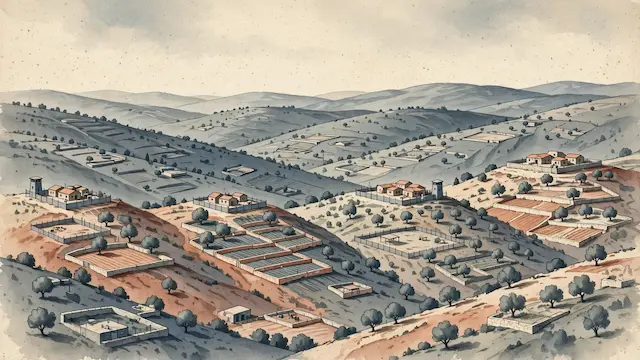
Four new Israeli settlement outposts have been established in the Hebron Governorate in the southern West Bank, stretching across areas from the southeast to the southwest, between Yatta, Dura, and Dahariya, and west of Hebron. These moves coincide with a ten-day Israeli military lockdown in western Hebron neighborhoods. The outposts, initially pastoral and agricultural, are seen as a means to impose new geographical realities, enhance control over Palestinian land, and restrict movement between Palestinian communities and their agricultural areas.
The establishment of these outposts follows an October 24 announcement by the regional council of Mount Hebron settlements regarding a plan for eight new outposts. This plan was reportedly a response to a shooting attack by Ahmad and Hamoud Al-Jab'a near the Furs Al-Hawa junction, which killed two Israeli soldiers and wounded three others before the perpetrators were killed. However, settlers began establishing an outpost on Dahariya land in the Jweia area, between Dahariya and the village of Beit Al-Roush Al-Fouqa, just hours after the attack. The Palestinian Wall and Settlement Resistance Commission in Hebron estimates that settlers have seized approximately 400 dunams under the pretext of state land designation.
In the northeast of the governorate, the settlement of Bani Kedem, previously an outpost of Metsad (also known as Eshtemoa), has been officially recognized. The Israeli Ministerial Committee for Political and Security Affairs decided in December 2025 to convert the outpost into an independent settlement. Analysts suggest that legalizing outposts signifies an advanced stage of entrenching settlement facts on the ground, enabling official budgets, infrastructure development, and service expansion, transforming unofficial sites into recognized Israeli settlements. Palestinian estimates indicate efforts to connect Bani Kedem with the Nigehot settlement, further consolidating the settlement network.
Concurrently with the outpost establishment, Israeli forces, under directives from Finance Minister Bezalel Smotrich, demolished around 15 Palestinian commercial and industrial structures near the Furs Al-Hawa junction, citing security reasons. Observers believe this tactic of using security pretexts to target economic facilities weakens Palestinian economic activity and access to land and livelihoods. Settlers also attempted to establish an outpost west of Hebron between Beit Kahil and Furs Al-Hawa by raising Israeli flags on private Palestinian land and vandalizing structures, but these efforts have not yet resulted in a permanent outpost due to the land's private ownership status.
In the Masafir Yatta area, three new pastoral outposts were established in the days following the Furs Al-Hawa incident, with ongoing efforts to expand them and bring in settlers. These outposts, located near Palestinian homes and agricultural lands, involve tents, wooden structures, and mobile homes, along with livestock. An armed settler named Shim Tov is reportedly leading some of these activities in Yatta. The Israeli military has also continued to close gates leading to Masafir Yatta, confiscate Palestinian vehicles, and restrict access to bypass roads, actions that observers note amplify the impact of settlement expansion.
Analysts suggest that the convergence of settlement activities with military restrictions, including road closures and demolitions, indicates a widening scope of Israeli actions beyond the initial incident site. This pattern in Hebron exemplifies the intertwining of military and settlement trajectories, potentially leading to increased fragmentation of Palestinian geography in the southern West Bank and hindering residents' access to their land and livelihoods. The new outposts could evolve into springboards for further settlement expansion and consolidation.
Mentioned
Not the same event — other stories that share this one’s people, places, or theme: background, reactions, and follow-ups.
