
Maritime Drones Pose Growing Threat to Shipping
Translated & summarized from Bizportal by baba
Maritime drones recently sank the container ship Contship Jet off Bulgaria, highlighting the growing threat to global shipping. Ukraine has effectively used these unmanned vessels against Russia, while the Houthis have employed them in the Red Sea. These low-cost, high-speed drones are difficult to defend against, posing significant risks to vulnerable merchant vessels and increasing shipping costs. Israel is also a developer of USV technology for both defense and potential offense.
The story in 5 lines · by baba
- Maritime drones sank the container ship Contship Jet off Bulgaria, with 20 hazardous containers lost.
- Ukraine has made USVs a key weapon against Russia, damaging numerous warships.
- The Houthi attacks in the Red Sea have included explosive boats and drones, sinking multiple vessels.
- USVs are cost-effective and difficult to defend against, posing a major threat to merchant shipping.
- Israel is a leading developer of USV technology for defense and export.
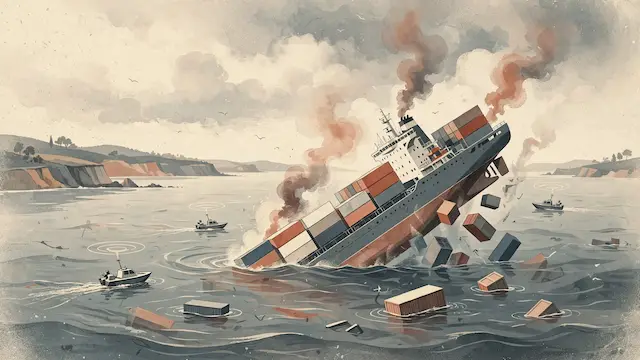
Three maritime drones struck the container ship Contship Jet, operated by ZIM, en route from Haifa to Constanta, Romania, causing the vessel to sink off the coast of Bulgaria. While all 18 crew members were rescued safely, approximately 20 containers carrying hazardous materials fell into the sea. This incident marks the fifth drone attack in Bulgaria's exclusive economic zone this month, with regional reports indicating at least six ships have been hit and a dozen seafarers endangered. The perpetrators remain unknown.
Ukraine has significantly integrated unmanned surface vessels (USVs) into its naval warfare, reportedly damaging around 20 Russian warships and destroying several, pushing the Black Sea Fleet eastward. In the Red Sea, Houthi forces have employed explosive boats, sinking the bulk carrier Tutor in 2024 and the Magic Seas and Eternity C in 2025, the latter resulting in crew fatalities. Israel is also a leader in developing and exporting USV technology, with companies like Rafael producing the Protector and Elbit manufacturing the Seagull, used for mine and submarine detection. These vessels allow navies to conduct reconnaissance and intelligence gathering near enemy shores without risking personnel.
Maritime drones, essentially uncrewed vessels controlled remotely or autonomously, are typically fast, low-profile boats equipped with explosives. Their low radar signature, high speed (over 70 km/h), and tendency to attack at night or in swarms make them difficult to detect and intercept, especially for defense systems designed for aerial threats. The cost-effectiveness of USVs, with Ukrainian Magura V5 drones costing an estimated $250,000-$275,000 compared to the $60-$70 million value of a Russian corvette they can sink, makes them an attractive weapon for various actors.
Merchant vessels, being large, slow, and unarmed, are particularly vulnerable. The sinking of the Contship Jet, which carried lithium-ion batteries, acids, and flammable liquids, has prompted environmental monitoring by Bulgarian authorities. The increasing use of USVs by Ukraine, the Houthis, and potentially Iran, alongside investments by major powers like the US, China, and Russia, highlights a growing global concern. Hamas also attempted to deploy a submersible drone against Israel in 2021.
Israel's naval defense focuses on protecting its economic waters and gas rigs with four Sa'ar 6 corvettes equipped with the C-Dome system, advanced radar, and short-range weapon stations. Patrol boats and observation systems, along with USVs for reconnaissance, are also employed. While details of Israel's offensive USV capabilities are classified, Israeli industries offer armed USVs for export, including Rafael's Protector and Elbit's Seagull, as well as the Israel Aerospace Industries' Katana.
The threat extends to Israeli interests, as evidenced by Hamas's 2021 attempt and the Houthis' ongoing threats against Israel-linked shipping, which have severely impacted traffic at the port of Eilat. The vulnerability of gas rigs in Israel's economic waters requires constant protection. The concept of explosive boats attacking ships is not new, dating back to the 2000 USS Cole bombing, but modern remote operation has made it more accessible and dangerous. These attacks increase war insurance costs for ships, leading to higher freight rates and consumer prices, further disrupting global shipping routes already strained by incidents in the Red Sea and the Strait of Hormuz.
Keep up with
Mentioned