
Bnei Brak Industrial Zone to Be Replaced by Housing and Public Spaces
Translated & summarized from Bizportal by baba
A plan to redevelop an old industrial zone in Bnei Brak into a mixed-use neighborhood has been approved. The project will replace industrial sites with 198 new apartments, commercial spaces, and a large public building. This transformation is part of a wider urban renewal effort in northwestern Bnei Brak, converting industrial areas into residential and commercial districts. The development aims to increase housing while expanding urban services in the densely populated city.
The story in 5 lines · by baba
- A plan to redevelop an old industrial zone in Bnei Brak into housing and public spaces has been approved.
- The project will add 198 new housing units to the city, with about 40 designated as small apartments.
- A large public building of 19,000 square meters is planned for educational, cultural, and health services.
- The development includes 1,000 square meters of commercial space and 3 dunams of open areas.
- This is part of a broader trend of converting industrial zones into urban districts in Bnei Brak.
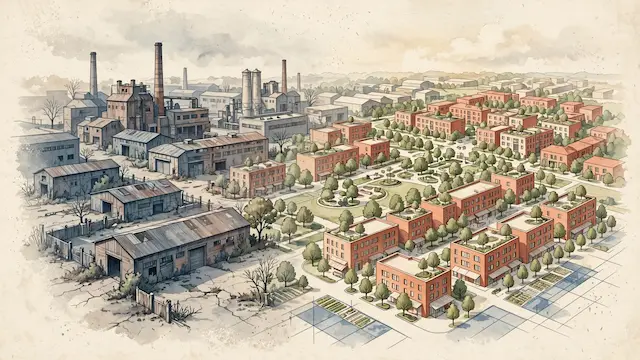
The Tel Aviv District Planning and Building Commission has approved a significant urban renewal plan for one of Bnei Brak's oldest industrial zones. The "Em HaMoshavot-HaMakabim" complex, spanning approximately 16 dunams at the intersection of Em HaMoshavot Road and HaMakabim Street, will transition from industrial use to a mixed-use neighborhood. The plan includes the construction of 198 housing units across seven buildings, each reaching 6.5 stories. Approximately 40 of these units will be designated as small apartments. A commercial frontage of about 1,000 square meters is planned along HaMakabim Street. A substantial public building of 19,000 square meters across 12 stories is also slated for development, intended to house educational, community, cultural, health, and religious services. This extensive public space allocation is notable given the city's density and high demand for such facilities. The project also allocates an additional 3 dunams for open spaces, incorporates a green roof, and includes pedestrian improvements and infrastructure upgrades. This initiative is part of a broader trend in northwestern Bnei Brak, where industrial areas are gradually being transformed into urban districts, complementing the nearby BBC business district. Previous plans in Bnei Brak have also focused on converting old employment zones into residential neighborhoods, including a 2020 plan for about 1,500 apartments on a 104-dunam site. The Em HaMoshavot-HaMakabim project's building height remains relatively low compared to the nearby BBC towers, creating a gradual transition in urban fabric. The plan, submitted by the Bnei Brak Local Committee and private stakeholders, now moves to detailed planning and building permit stages upon fulfillment of the commission's conditions.
Mentioned
The same event, reported separately by each outlet. Open a few to compare what different newsrooms emphasize — and what they leave out.
Centre 1Other 2


Not the same event — other stories that share this one’s people, places, or theme: background, reactions, and follow-ups.