
Cluster Bomb Remnants Pose Ongoing Threat After Conflict
Translated & summarized from Hamal by baba
A school trip in northern Israel turned deadly when a cluster bomb remnant exploded, killing one student and injuring 24. The incident has raised concerns about unexploded ordnance, particularly cluster submunitions, which are illegal under international law. Similar threats have been identified in central Israel, prompting authorities to suspend school trips in the north and issue safety warnings. The public is urged not to touch suspicious objects and to report them to the police.
The story in 6 lines · by baba
- A school trip explosion in northern Israel killed one student and injured 24 due to a suspected cluster bomb remnant.
- Unexploded ordnance, especially cluster submunitions, poses a significant ongoing danger to civilians in open areas.
- Cluster munitions are illegal under international law due to the high risk of unexploded remnants.
- Similar threats from cluster warheads have been reported in central Israel, including Tel Aviv.
- School trips in northern Israel have been suspended for 48 hours pending further risk assessment.
- Authorities are urging the public to report suspicious objects and avoid areas closed due to ordnance risks.
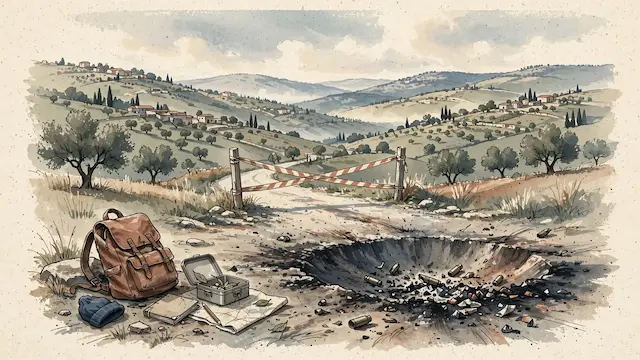
A deadly explosion during a school trip in northern Israel has reignited concerns over unexploded ordnance, particularly cluster bomb remnants, posing a danger to civilians in open areas. The incident, which occurred Monday near Moshavah Park on the Ramim Ridge, resulted in the death of student Elazar Yair and injured 24 others. Authorities suspect the blast was caused by a cluster submunition, an illegal weapon under international convention, previously fired by Hezbollah and left unexploded in the area. This event highlights how unexploded ordnance from past conflicts can continue to endanger lives long after hostilities cease.
Cluster munitions are designed to disperse dozens or even hundreds of smaller bomblets over a wide area. Some of these bomblets fail to detonate upon impact, remaining as dangerous unexploded ordnance. These submunitions can be difficult to identify, especially when concealed by terrain or vegetation, and even accidental contact or movement can trigger an explosion. Israel has previously been accused of using such munitions, which are banned by international treaties due to the significant risk posed by their remnants to civilians, including children, years later. While the military has not admitted to developing similar weapons recently, its artillery arsenal includes cluster-like munitions with a much lower dud rate.
The danger is particularly acute in areas that have seen prolonged fighting. Unexploded ordnance can be found in agricultural fields, forests, on trails, and in recreational areas. Children and teenagers are especially vulnerable, potentially picking up suspicious objects out of curiosity without realizing they are live munitions. Objects that have been in the ground for months or years remain hazardous.
The threat is not confined to the northern border. In March, security forces dealt with cluster warheads impacting central Israel, including Tel Aviv, following an Iranian barrage on March 22. Police sappers worked to neutralize additional dangers in the 17 impact zones. In another incident on March 24, an unexploded ordnance was found on a road in Rosh Ha'ayin after an Iranian missile attack, requiring sapper intervention.
In response to the Ramim Ridge tragedy, engineering and sapper forces have begun searching for additional ordnance. Questions have also been raised regarding the approval of the school trip in an area known to be at risk. Minister of Education Yoav Kisch announced a 48-hour suspension of planned trips in the north pending further risk assessment. The public is advised that in case of finding a suspicious object, one should not touch or move it, but rather move away, keep others clear, and report it to the police. Areas closed to the public should not be entered until explicit clearance is given by authorities, as even old ordnance can detonate.
Mentioned
The same event, reported separately by each outlet. Open a few to compare what different newsrooms emphasize — and what they leave out.
Left 1Centre 2Right 1Haredi 1Arab 1Other 2







Not the same event — other stories that share this one’s people, places, or theme: background, reactions, and follow-ups.




