
Global Markets Brace for Volatility Amid Rising Bond Yields and Oil Prices
Translated & summarized from Israel Hayom by baba
Global financial markets face a crucial week with high U.S. bond yields, rising oil prices, and inflation concerns, according to investment experts. Analysts warn of continued volatility due to interest rate policies, energy costs, and AI investments, with U.S. 10-year bond yields hitting a 24-year high. Opportunities are seen in AI, quantum computing, defense, and digital currencies, though market direction hinges on upcoming U.S. inflation data and bank earnings reports.
The story in 6 lines · by baba
- Global markets face a critical week with high U.S. bond yields and rising oil prices.
- U.S. 10-year bond yields reached a 24-year high of 5.364% on October 7.
- Experts warn of renewed inflation risks due to the conflict with Iran impacting oil prices.
- Investment opportunities are identified in AI, quantum computing, defense, and digital currencies.
- Upcoming U.S. inflation data and bank earnings reports will test market sentiment.
- Bitcoin is projected to reach $110,000 by the end of 2026, according to one analyst.
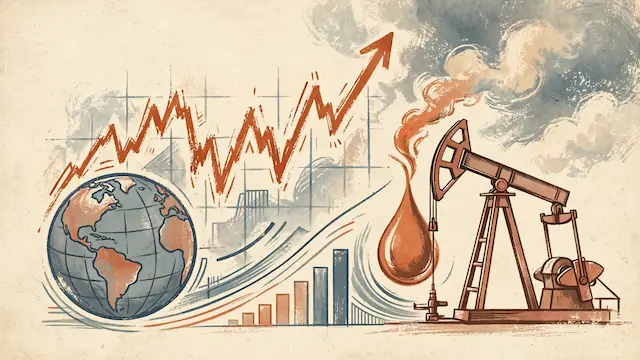
Global financial markets are entering a critical trading week, facing a confluence of high U.S. bond yields, surging oil prices, renewed inflation fears, and the start of the corporate earnings season on Wall Street. Three international investment experts are warning of continued market turbulence but also identifying new investment opportunities.
Violetta Todorova, a research analyst at Leverage Shares, highlighted four pressures on the U.S. bond market: the Federal Reserve's interest rate policy, energy prices, the government deficit, and massive investments in artificial intelligence. She noted that on October 7, the 10-year U.S. bond yield reached 5.364%, a 24-year high, with the 30-year yield nearing 5.7%. These yields increase borrowing costs for businesses and households, making stocks relatively less attractive. Todorova specifically cautioned about the impact of the conflict with Iran on oil prices, stating that despite improved tanker traffic in the Gulf, Brent crude remained between $94 and $110 per barrel. A prolonged crisis could reignite inflation, deter interest rate cuts, and hurt corporate profits.
Silvia Jablonski, Chief Investment Officer at Defiance, believes the high-interest-rate environment necessitates distinguishing between tech companies reliant on future expectations and those already generating substantial profits. However, Jablonski sees long-term potential in the AI revolution, with investments expanding beyond chipmakers to include power infrastructure, memory, communications, and data centers. She cited Nvidia, Micron, and Broadcom as examples. Other growth areas include quantum computing, with companies like IBM and IonQ, and defense industries focusing on drones, autonomous systems, and electronic warfare, mentioning Israel's Elbit Systems.
Meanwhile, Paul Marino, Chief Revenue Officer at Themes ETF’s, anticipates the digital currency market is nearing the end of a weak period. He forecasts Bitcoin could reach approximately $110,000 by the end of 2026 and set new records in 2027, driven by increased institutional investment, ETF activity, and limited Bitcoin supply. Marino stressed that this growth depends on improved liquidity and declining bond yields.
The upcoming week will test markets with the release of U.S. inflation data and the start of the earnings season for major banks, including JPMorgan. These events could determine whether investors continue to favor bonds over stocks or if expectations of monetary easing will drive demand back to riskier assets.
Mentioned
