Middle East War, Energy Costs Dominate IMF-World Bank Meetings
Translated & summarized from Arab48 by baba
The IMF and World Bank annual meetings in Bangkok will focus on the Middle East war, high energy costs, and debt burdens. Global financial leaders face the challenge of supporting growth and households with limited government funding. Record interest payments on external debt for developing nations highlight fiscal constraints. The conflict's impact on energy prices and trade routes, particularly for Gulf states, will also be discussed.
The story in 5 lines · by baba
- Middle East war and rising energy costs dominate IMF-World Bank meetings in Bangkok.
- Governments face limited capacity to fund new responses amid debt and fiscal pressures.
- Interest payments on external debt for low- and middle-income countries hit a record $415.4 billion in 2024.
- The closure of the Strait of Hormuz caused significant economic losses for Gulf oil exporters.
- World Bank President Ajay Banga noted mounting pressures from energy, fertilizers, and debt.
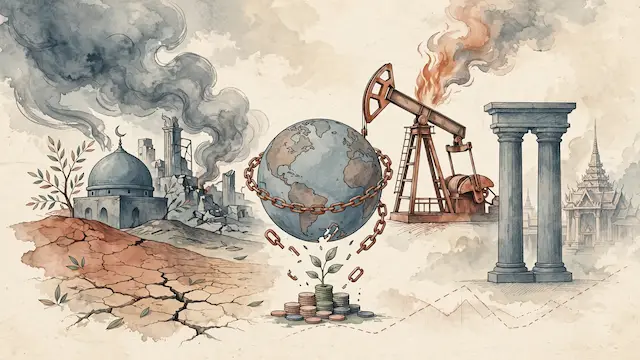
Bangkok is set to host the annual meetings of the International Monetary Fund (IMF) and the World Bank, with global financial officials grappling with the pressures of the Middle East war, rising energy costs, and increased borrowing expenses. Participants face the challenge of protecting economic growth and households, given many governments' limited capacity to fund new responses. The meetings commence amidst overlapping trade and financial shocks compounded by existing debt burdens, making the provision of funds only a partial solution. While spending to alleviate price increases may offer temporary consumer relief, it requires financing, at a time when high interest rates are escalating borrowing costs and narrowing fiscal options. Reuters reported on Sunday, October 11, that the "American-Israeli war with Iran" and its inflationary consequences would be a central topic of discussion. World Bank President Ajay Banga noted that pressures from energy, fertilizers, and debt are mounting again, despite global growth proving more resilient than anticipated during supply disruptions. According to the IMF's official schedule, briefings on the World Economic Outlook and Global Financial Stability will occur on October 13, followed by the Fiscal Monitor briefing the next day. These reports assess growth, financial risks, and fiscal balances within a unified framework, with their findings to be released at the briefings. The World Bank confirmed that the plenary session will include Banga, IMF Managing Director Kristalina Georgieva, and Carlos Carvalho Spalding, Governor of the Central Bank of Paraguay and chair of the meetings. The week's events will also cover investment, employment, growth, and practical development solutions. Georgieva, speaking at a dialogue in Singapore on October 7, explained the political pressures associated with debt, stating that governments face increasing demands for assistance amid successive shocks, while reducing deficits and debt becomes more difficult the longer action is delayed. Singaporean President Tharman Shanmugaratnam cautioned in the same dialogue that the exhaustion of fiscal space could shift crisis response burdens to central banks, raising risks of increased borrowing and speculation, and potentially leading markets to rely repeatedly on monetary authorities' intervention during disruptions rather than addressing the underlying fiscal causes. World Bank data highlights the scale of the challenge preceding these meetings. The International Debt Report 2025 indicated that interest payments on external debt for low- and middle-income countries reached a record $415.4 billion in 2024, a 2.2% increase, marking the second consecutive year of record highs. These countries also paid $205.1 billion more in principal and interest in 2024 than they received in new loans. These historical figures, illustrating external financing flows rather than current war costs, explain the narrow maneuvering room many nations enter this period of rising costs with. In a regional update, the World Bank stated that the closure of the Strait of Hormuz inflicted the largest economic losses on oil-exporting Gulf states, unlike previous energy shocks that typically benefited them. It also noted that shipping disruptions are increasing import costs and pressuring food prices, underscoring how the crisis's effects vary among countries instead of being a single global trend.
Mentioned
The same event, reported separately by each outlet. Open a few to compare what different newsrooms emphasize — and what they leave out.
Centre 1Arab 1