Israel Expands Gaza Control a Year After Ceasefire
Translated & summarized from Arab48 by baba
On the first anniversary of a Gaza ceasefire, the Israeli military advanced into the Shujaiya neighborhood, moving the "Yellow Line" westward and displacing dozens of families. This expansion increased Israel's control over Gaza from 53% to over 63% of the territory since the agreement. The Gaza government media office documented 5,474 Israeli violations over the year, including 1,488 deaths and 5,280 injuries, and criticized restrictions on aid and travel.
The story in 6 lines · by baba
- Israeli forces advanced in Gaza's Shujaiya neighborhood, moving the "Yellow Line" westward and displacing residents.
- The Israeli military has expanded its control over Gaza to over 63% of the territory in one year.
- The Gaza government documented 5,474 Israeli violations during the year-long ceasefire.
- Over 1,488 Palestinians were killed and 5,280 injured due to Israeli violations in the past year.
- Aid delivery and civilian travel into Gaza remain significantly below agreed-upon levels.
- Prime Minister Netanyahu stated Israel will not return areas occupied during the war.
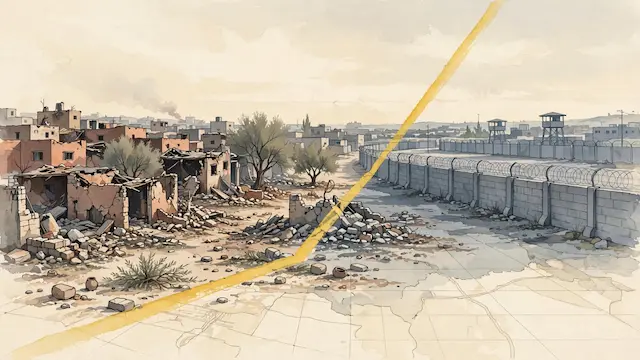
On Sunday, the Israeli military expanded its control east of Gaza City, advancing dozens of meters into the Shujaiya neighborhood and moving the concrete barriers marking the "Yellow Line" westward. This advance brought new Palestinian homes under Israeli control and forced dozens of families to flee their homes, coinciding with the one-year anniversary of a ceasefire agreement. Local sources reported that Israeli military vehicles had advanced beyond their previous positions in Shujaiya overnight Saturday to Sunday, under heavy fire, artillery shelling, and drone surveillance. Residents were surprised Sunday morning to find the concrete blocks defining the "Yellow Line" had been moved to new locations further west.
Sources indicated that the gunfire extended from the vegetable market area in the eastern part of the neighborhood towards the Shujaiya junction on Salah al-Din Street, damaging homes and tents of displaced people. Medical sources reported that two Palestinians, including a pregnant woman, sustained moderate injuries and were taken to Al-Ahli Arab Hospital. During the night, the Israeli military also carried out demolitions of buildings and homes in the vicinity, accompanied by intense explosions, before their vehicles withdrew. The repositioning of the "Yellow Line" barriers kept the area under Israeli control and led to the displacement of dozens of families towards the western parts of Gaza City.
The "Yellow Line" demarcates the area where the Israeli army is deployed in the eastern Gaza Strip from the areas where Palestinians are permitted to remain to its west. Since the ceasefire, the line has transformed from a withdrawal line into a moving border gradually pushed westward by Israel, according to field data. When the agreement began, the Israeli military maintained control over approximately 53% of the Gaza Strip. After a year, this figure rose to over 63%, based on Israeli data published in early October. Prime Minister Benjamin Netanyahu stated on September 30 that his government would not return areas occupied by the army during the war to Palestinians, reflecting an Israeli refusal to withdraw from areas where the army's deployment has expanded over the past year.
The new expansion in Shujaiya follows about a week of repeated demolitions, gunfire, and artillery shelling in the eastern Shujaiya and Al-Tuffah neighborhoods, alongside military movements along the "Yellow Line." In parallel with the expanding field of control, the Gaza government media office stated on Sunday that it had documented 5,474 Israeli violations over the past year of the ceasefire, resulting in the deaths of 1,488 Palestinians and injuries to 5,280 others, in addition to the arrest of 203 Palestinians. The Gaza Ministry of Health reported that the number of martyrs since October 11, 2025, reached 1,488, with 5,281 injured, and the recovery of 836 bodies during the same period. In the last 24 hours alone, seven bodies were brought to Gaza hospitals, along with 28 injuries.
The government media office stated that the violations included restrictions on the entry of aid and the movement of people. According to its data, only 74,855 trucks of humanitarian aid entered the Strip in one year, out of an expected 219,000 trucks according to the agreement, representing about 34% compliance. Regarding travel, the office reported that 14,012 people were able to move in and out of the Gaza Strip, out of an expected 36,800, a rate of 38%. The office called on mediators and parties sponsoring the agreement to compel Israel to implement its terms and cease violations, as field developments indicate the "Yellow Line" itself has become a prominent manifestation of the changed reality imposed by Israel over the past year of the ceasefire.
Mentioned
The same event, reported separately by each outlet. Open a few to compare what different newsrooms emphasize — and what they leave out.
Arab 2

Not the same event — other stories that share this one’s people, places, or theme: background, reactions, and follow-ups.