Beyond Oil and Armies: The Quiet Infrastructure of National Resilience
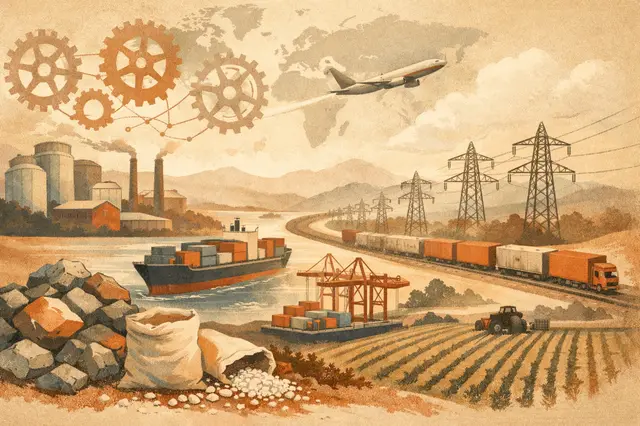
Public debate about shipping lanes, geopolitical tensions, and security threats usually centers on oil, military power, and defense. But the article argues that a quieter struggle is now just as important, control over supply chains, raw materials, and the ability to keep economies and essential services stable. In the 21st century, power is not only ballistic, but also economic, industrial, and logistical.
Disruptions on maritime trade routes such as the Strait of Hormuz do more than raise energy prices. They quickly ripple into commodity markets, agriculture, food production, input costs, production uncertainty, and supply chain breakdowns. Over recent years, export restrictions on raw materials, geopolitical crises, and sharp swings in commodity markets have deepened that reality. Minerals and fertilizers, the article says, are no longer ordinary products, they are critical infrastructure for the global economy and for food security.
The article places this in a long-term context. World population has grown from about 4 billion in the 1970s to more than 8 billion today, and is expected to reach nearly 10 billion by mid-century. At the same time, land and water resources are shrinking and climate change is making farming less stable. The challenge, therefore, is to produce more food with fewer resources and under more difficult conditions. That is where mineral-based industry becomes important, not just as extraction, but as value creation through knowledge, technology, and advanced applications that help farmers raise yields, use water more efficiently, and reduce food waste, including through ingredients that extend shelf life.
For Israel, the article says, the issue is even broader. Alongside high tech, the country has a deep industrial base built on minerals, processing, research and development, and global reach. That industry is not only an export engine but also a regional economic anchor in the periphery, providing tens of thousands of jobs, supporting local supply chains, and creating stable, skilled employment. In a less stable and more polarized world, globally active, reliable, and responsible industrial players matter more. Sovereignty in the 21st century, the article concludes, is measured not only by borders and military strength, but also by the ability to produce and supply resources the world depends on. The silent infrastructure of minerals, fertilizers, and supply chains is part of national strategic power.