
Israeli Housing Dream Recedes as Salaries Lag Far Behind Soaring Property Prices
Translated & summarized from Ice by baba
The dream of homeownership in Israel is increasingly out of reach, with 160-164 average salaries now needed for a property, rising to 350 in some Tel Aviv areas. Limited savings capacity and high down payment requirements make it nearly impossible for most to buy a home. While average mortgage payments have decreased due to interest rate cuts and the purchase of cheaper homes, overall property prices have seen only a minor national decline, with significant drops concentrated in Tel Aviv.
The story in 5 lines · by baba
- 160-164 average salaries are now required to purchase a home in Israel.
- A Tel Aviv apartment can require up to 350 average salaries for purchase.
- Saving enough for a down payment is nearly impossible for most Israelis.
- Average mortgage payments have fallen due to interest rate cuts.
- Overall property prices have seen minimal national decline, with Tel Aviv experiencing significant drops.
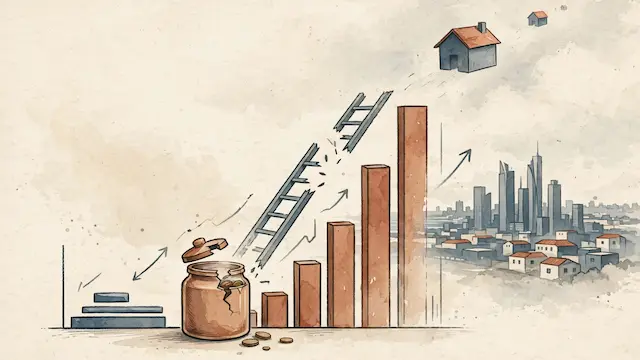
The aspiration of owning a home in Israel is becoming increasingly unattainable for the average citizen, with current data indicating that 160 to 164 average salaries are now required to purchase a property. This figure is based on an average monthly income of 14,000 shekels and an average property price of approximately 2.3 million shekels. The situation is significantly worse in Tel Aviv, where purchasing a typical apartment demands over 300 salaries, and in some areas, as many as 350. In contrast, buying a home in Haifa requires around 135 salaries, and in Beersheba, 96 salaries are needed.
The primary obstacle is the public's limited ability to save, as disposable income is shrinking. Even saving 10% of one's salary would necessitate 1,600 salaries, or 133 years, far exceeding the average lifespan. Acquiring a home typically requires a substantial down payment of hundreds of thousands of shekels, accumulated through savings, inheritance, or family assistance.
High-tech employees, earning an average net salary of 31,000 shekels, face a more manageable but still challenging requirement of approximately 71 salaries for an average apartment, though the article questions if this net figure is realistic. Meanwhile, the average mortgage payment in Israel decreased by 4.8% year-on-year in the second quarter to 10,864 shekels. This reduction is attributed to the purchase of less expensive homes or downsizing, rather than a widespread drop in property prices. Investor mortgage payments, however, rose by 17%.
Ramot Gan saw a notable 12.2% decrease in average mortgage payments, with other cities like Bnei Brak and Bat Yam also experiencing declines. Tel Aviv's average mortgage payment dropped 7.4%, despite remaining higher than in other cities. Jerusalem and Ashdod showed minimal change, while Petah Tikva saw a 5% decrease. A significant factor contributing to these lower average payments is a series of five interest rate cuts, which have reduced average monthly mortgage costs by hundreds of shekels.
Despite these payment reductions, property prices have only fallen by less than 2% nationally over the past year, a figure that masks dramatic drops in Tel Aviv, which influences the overall market. Peripheral areas, however, have seen price stability or even slight increases. New apartment purchases are often accompanied by financing incentives from developers, leading to lower actual monthly repayments due to smaller mortgage amounts. This trend has prompted some financing and insurance companies to offer 40-year mortgages.
