
US Military Disrupts Ship Attempting to Breach Iran Naval Blockade
Translated & summarized from Panet by baba
The U.S. military disabled a commercial cargo ship in the Gulf of Oman on Saturday after it ignored warnings and tried to breach the naval blockade on Iran. A U.S. fighter jet struck the ship's propulsion system, disabling it without crew injury. The incident occurred after the ship departed an Iranian port, prompting U.S. Central Command to warn other vessels. The disruption follows a recent increase in attacks on oil tankers, impacting shipping through the Strait of Hormuz.
The story in 5 lines · by baba
- U.S. military disabled a cargo ship in the Gulf of Oman for attempting to breach Iran's naval blockade.
- A U.S. fighter jet struck the ship's propulsion system, disabling it without crew injury.
- The ship, the Ocean Majestic, had departed an Iranian port before the incident.
- U.S. Central Command warned shipping companies to adhere to blockade warnings.
- The incident occurred amid increased attacks on oil tankers and concerns over shipping disruptions.
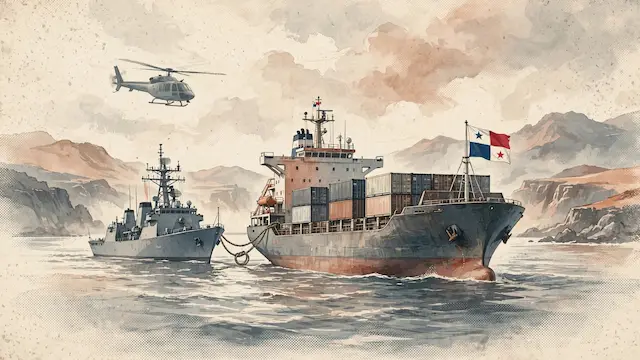
The U.S. military announced on Saturday that it disabled a commercial cargo ship in the Gulf of Oman after the vessel ignored warnings and attempted to breach the existing naval blockade on Iran. The U.S. Central Command stated on X that an American military fighter jet "precision-guided munitions" struck the stern of the Panama-flagged ship, the Ocean Majestic (also known as Erika Sun), fully disabling its propulsion system without harming the crew. The command added that the ship had tried to cross into territorial waters after departing an Iranian port. Reuters has not yet been able to reach the ship's operator for comment. U.S. Central Command alerted shipping companies in the Gulf of Oman and surrounding areas of the Strait of Hormuz to adhere to blockade warnings, monitor broadcasts for mariners, and communicate with the U.S. Navy. The number of ships transiting the vital strait has fallen to its lowest point in over two months, following a surge in attacks on oil tankers last week to their highest level since the U.S. and Israel began their war against Iran in February. This has raised concerns about shipping disruptions and support for crude oil prices. Before the war, the Strait of Hormuz handled 20% of global oil consumption.


