
KGM Musso Review: A Refined Pickup Truck Priced Competitively
Translated & summarized from Walla by baba
The KGM Musso, a redesigned pickup truck, has been launched in Israel at 275,000 shekels, positioning it as a more affordable alternative to competitors like the Toyota Hilux and Isuzu D-Max. It features a modern design, a deep cargo bed, and a well-equipped, comfortable interior. The Musso is powered by a 2.2-liter turbo-diesel engine offering adequate performance and reasonable fuel economy, though its transmission can be slow. While offering improved on-road comfort and decent off-road capability, its automatic rear differential lock can be less refined in technical terrain.
The story in 6 lines · by baba
- The KGM Musso pickup truck is priced at 275,000 shekels in Israel, significantly undercutting rivals like the Toyota Hilux and Isuzu D-Max.
- The new Musso features a modern design, a deeper cargo bed than competitors, and a comfortable, tech-filled interior with two 12.3-inch screens.
- It is powered by a 2.2-liter, 202-horsepower turbo-diesel engine with a 6-speed automatic transmission, offering adequate performance and 9.4 km/liter fuel economy.
- The Musso provides improved on-road comfort compared to previous generations, though its transmission can be slow to respond.
- Off-road capability is decent with good approach/departure angles, but the automatic rear differential lock engages abruptly in technical terrain.
- The importer is considering offering versions with more comfortable rear coil springs for enhanced ride quality.
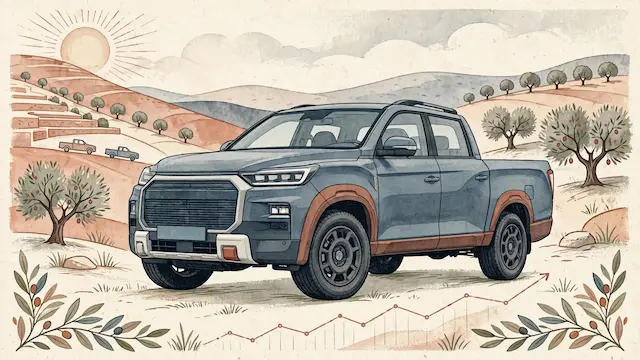
The fourth generation of the KGM Musso pickup truck has arrived in Israel, offering significant improvements in refinement and features compared to its predecessors. Priced at 275,000 shekels, it undercuts key competitors like the Toyota Hilux and Isuzu D-Max, which can cost tens of thousands more when similarly equipped. While not a budget option, its price point is considered attractive, especially with plans for potentially lower-priced versions for institutional tenders that might reach the private market around 250,000 shekels.
The Musso boasts a more aggressive and modern design than the outgoing model, with a robust front end and a lengthy, visually appealing profile. Its cargo bed is notably deeper than those of its rivals, measuring 57 cm compared to the Hilux's 48 cm, and comes with a plastic liner and eight tie-down hooks. A full-size spare tire is mounted on the rear of the bed, though a more integrated solution is expected in the future.
Inside, the Musso offers a comfortable and well-equipped cabin, aiming to serve as a family vehicle as well as a workhorse. It features comfortable faux-leather seats, heated and electric front seats, and a modern dashboard dominated by two 12.3-inch screens supporting Android Auto and Apple CarPlay. While connectivity can occasionally be unstable and some dashboard text is small, the overall interior quality and spaciousness are praised for the category.
Under the hood, the Musso is powered by a 2.2-liter, 202-horsepower turbo-diesel engine paired with a 6-speed automatic transmission. The powertrain provides adequate power for daily driving and comfortable highway cruising, achieving a respectable 9.4 km/liter in mixed driving conditions. However, the transmission can be slow to respond, particularly during quick overtaking maneuvers, and the engine, while strong, is outpowered by the Toyota Hilux's larger displacement engine.
In terms of driving dynamics, the Musso offers a more refined ride than many traditional pickup trucks, thanks to improved suspension tuning and new shock absorbers. While it can still feel a bit bouncy without a load, it provides a comfortable experience on good roads. Off-road capabilities are solid, with good approach and departure angles, and a capable 4x4 system. However, its long wheelbase and the automatic rear differential lock, which engages abruptly, can make challenging technical terrain more difficult than for some competitors. The importer, Telecar, is considering bringing in versions with more comfortable rear coil springs, which would reduce payload capacity but enhance ride comfort for those not carrying heavy loads.