
Israel Suffocates Under Waste Fires, Demanding National Plan
Translated & summarized from Zman Yisrael by baba
Israel is facing a severe waste crisis marked by widespread illegal burning of half a million tons of waste annually, causing significant air pollution and health damage. The problem, linked to 75% of carcinogenic emissions and thousands of deaths, is exacerbated by insufficient government action and a lack of national strategy. Environmental groups are urging the next government to implement a comprehensive national plan, increase enforcement, and provide resources to tackle the crisis, with a public campaign planned for October 11th.
The story in 6 lines · by baba
- Hundreds of thousands of Israelis are affected daily by severe air pollution from illegal waste fires.
- Approximately 500,000 tons of waste are illegally burned annually in Israel, contributing to health crises.
- Waste fires are responsible for 75% of carcinogenic emissions and nearly a third of PM2.5 particles in Israel.
- The crisis is attributed to a failure across multiple government ministries and inadequate local authority performance.
- Environmental organizations are calling for a national plan and increased government action to combat the waste problem.
- A public campaign is scheduled for October 11th to pressure political parties to address the waste crisis.
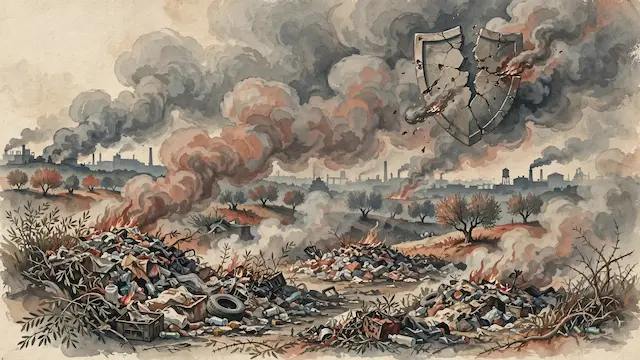
Despite pleasant weather, many Israelis are unable to open their windows due to severe air pollution from widespread waste fires. Residents report stinging eyes and clothes smelling of smoke, with some forced to close windows even at night. These fires, which occur from the northern Golan Heights to the Arava desert, are not isolated incidents but a chronic national problem. Approximately 500,000 tons of household, industrial, and agricultural waste are illegally burned annually in Israel, a practice likened to that in third-world countries. Contractors operate illegal disposal sites, burning waste to reduce volume, while farmers burn agricultural debris and plastic. Weak local authorities with inadequate waste collection also see waste burning in the streets. The problem extends to the Palestinian Authority, where makeshift dumps burn daily, with smoke drifting across borders.
The health consequences are dire, with waste fires accounting for 75% of carcinogenic emissions and nearly a third of PM2.5 particles in Israel. These pollutants penetrate deep into the respiratory system and are linked to approximately 4,700 deaths annually. The article argues that waste fires are a symptom of a larger, unprecedented waste crisis. Israel generates more waste per capita than most developed nations, with low rates of waste separation and recycling, and most waste is landfilled. Long distances to landfills, coupled with high transport costs, encourage illegal waste disposal. Landfill capacity is also dwindling, exacerbating the issue.
The failure to address this crisis spans multiple government ministries, not just the Ministry of Environmental Protection, which is criticized for slow infrastructure development and weak enforcement. The Ministry of Interior is accused of ignoring the poor performance of local authorities, while the police rarely enforce waste laws. Fire services do not extinguish all waste fires, the Ministry of Agriculture has not provided solutions for agricultural waste, and the Ministry of Health has not assessed the public health impacts. The Ministry of Finance has not allocated sufficient budgets, the Ministry of Justice opposes regulations to curb burning, and the Ministry of Defense and Civil Administration are insufficient in combating fires beyond the Green Line. Environmental organizations like Citizens for Clean Air have received over 20,000 reports in two years and have pushed for enforcement units and legislation, but their efforts cannot replace government policy.
With upcoming Knesset elections, the incoming government must prioritize this issue. The article calls for a national plan to manage waste, increase enforcement, foster inter-agency cooperation, and assist struggling local authorities. It suggests establishing a professional, independent waste authority to formulate policy and implement solutions. The CEO of Citizens for Clean Air, Yiniv Bleicher, emphasizes that the high mortality rates, economic damage, and environmental harm necessitate direct leadership from the next prime minister. Citizens are urged to demand action from their elected officials, with a national "Suffocation Day" planned for October 11th to call on party leaders to commit to addressing the crisis.
Mentioned



