Palestinian Authority Postpones Elections Amid Security and Political Concerns
Translated & summarized from Channel 9 by baba
The Palestinian Authority has postponed its parliamentary elections, initially set for November 28, citing worsening security, political, and economic conditions. Vice President Hussein al-Sheikh stated that conditions for fair elections had not been met, citing unfulfilled expectations from U.S. and UN initiatives. Officials recommended a delay of several months to continue internal dialogue, with organizational challenges in Gaza and Jerusalem also contributing. This postponement, following a previous delay in 2021, casts doubt on leadership renewal and reform efforts.
The story in 6 lines · by baba
- Palestinian Authority postpones parliamentary elections, first in 20 years, citing security and political deterioration.
- Vice President Hussein al-Sheikh cited unmet conditions and obstacles to a fair and comprehensive vote.
- PA leadership expected improvements from U.S. and UN initiatives that did not materialize.
- Officials recommended postponing elections for months and continuing Palestinian political dialogue.
- Organizational issues in Gaza and Jerusalem, plus the Fatah-Hamas split, are key obstacles.
- This delay follows a previous postponement in 2021 and raises questions about leadership renewal.
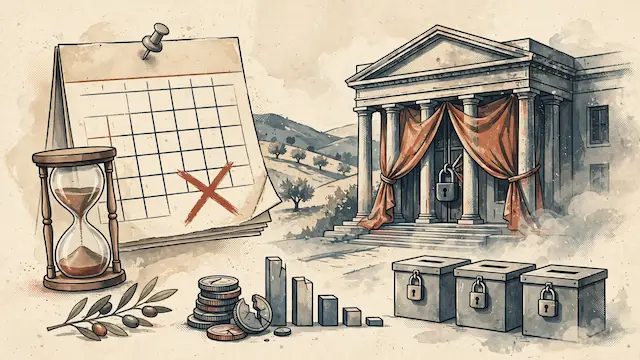
The Palestinian Authority has postponed its parliamentary elections, originally scheduled for November 28, which would have been the first in two decades. A new date for the vote has not yet been announced. Officials in Ramallah cited a deteriorating political, economic, and security situation as the reasons for the delay.
In a letter dated October 8 to French Foreign Minister Jean-Noël Barrot, Palestinian Authority Vice President Hussein al-Sheikh stated that the conditions for holding elections on November 28, 2026, had not materialized. He explained that proceeding under current circumstances would face significant obstacles jeopardizing the comprehensiveness, freedom, and fairness of the electoral process.
Al-Sheikh's letter indicated that Palestinian leadership had anticipated improvements stemming from a U.S. peace initiative by President Donald Trump and a UN Security Council resolution. These were expected to include the deployment of international forces and local police in Gaza, the disarmament of Hamas, and the withdrawal of the IDF from the enclave. Additionally, Ramallah had hoped for measures against further Israeli expansion in Judea and Samaria and East Jerusalem suburbs, as well as the release of nearly $7 billion in Palestinian Authority funds held by Israel. However, the letter asserted that these steps and promises were not fulfilled, and the situation in the territories has worsened.
Following an assessment, PA officials recommended that Palestinian Administration Chairman Mahmoud Abbas postpone the elections for several months and continue dialogue among Palestinian political factions. The potential postponement had been known since October 8, following discussions among Palestinian factions in Cairo. Islamic Jihad's Deputy Secretary-General Mohammed al-Hindi stated that parties agreed to postpone the elections and resume national dialogue, though Fatah, Abbas's party, indicated a final decision was still pending.
Organizational issues in Gaza and Jerusalem remain a major hurdle, including difficulties in delivering ballot boxes and materials. The ongoing Fatah-Hamas split, which led to Hamas controlling Gaza in 2007 after winning the 2006 parliamentary elections, further complicates matters. The last parliamentary elections were held in January 2006, and presidential elections in 2005. Abbas had previously postponed elections scheduled for 2021. This latest delay raises questions about the prospects for renewing the PA's political leadership and meeting international partners' demands for reform.
Mentioned
The same event, reported separately by each outlet. Open a few to compare what different newsrooms emphasize — and what they leave out.
Centre 4Right 2Arab 2Other 4












Not the same event — other stories that share this one’s people, places, or theme: background, reactions, and follow-ups.