
France Faces Financial Crisis, Becoming Europe's 'Sick Man'
Translated & summarized from Maariv by baba
France is facing a significant financial crisis, with its debt-to-GDP ratio at 121% and soaring borrowing costs, earning it the label of Europe's "sick man." This economic distress, coupled with political instability and rising defense expenditures across the continent due to Russian threats and U.S. pressure, is impacting the entire Eurozone. While other European nations like Germany, Italy, and Spain also face economic headwinds, Israel's economic data appears more robust, benefiting from demand for its specialized exports.
The story in 6 lines · by baba
- France's debt-to-GDP ratio has reached 121%, leading to its designation as Europe's "sick man."
- French 10-year bond yields have surged to 4.9%-4.96%, a level not seen since July 2002.
- European nations are increasing defense spending to 2.2%-2.4% of GDP due to Russian threats and U.S. demands.
- Germany is experiencing challenges with its automotive industry and rising inflation.
- Italy and Spain are also facing economic difficulties with high debt and deficits.
- Israel's economic indicators are presented as encouraging, contrasting with European trends.
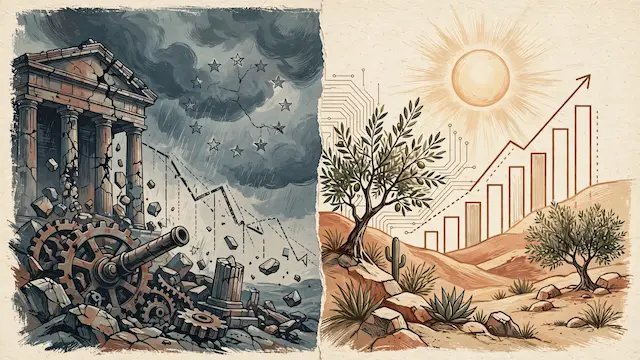
France is experiencing a severe financial crisis, with its debt-to-GDP ratio reaching 121%, leading to its designation as Europe's "sick man." This situation is exacerbated by rising capital raising costs, with French 10-year bond yields hitting 4.9%-4.96%, a level not seen since July 2002. The government's borrowing costs have surged dramatically, from 0.7%-0.9% five years ago to 5.33%-5.5% now, hindering economic function. France's economic growth is a mere 0.7%, with a budget deficit of 5% of GDP.
The crisis is partly attributed to France's policies regarding immigration and integration, which have led to widespread student and youth riots. The country's financial struggles are projected to impact the entire Eurozone. Political instability, with upcoming presidential elections in April where far-right leader Marine Le Pen and radical left-winger Jean-Luc Mélenchon are leading contenders, further complicates structural reforms.
Across Europe, increased defense spending is a growing concern, driven by the ongoing threat from Russia and demands from the U.S. for European self-reliance. The EU's defense budget is set to reach 2.2% of GDP, with Eurozone countries at 2.4%, a historic high of 454 billion euros. This increase, coupled with rising capital costs, is affecting other European economies. Germany, for instance, faces challenges with its automotive industry decline and rising inflation, though its debt-to-GDP ratio remains lower than the Eurozone average.
Other major European economies like Italy and Spain are also grappling with economic difficulties, including high debt levels and deficits, although some, like Greece, are showing signs of growth despite significant challenges. Meanwhile, Israel's economic indicators are presented as encouraging, with lower inflation and interest rates compared to European nations, and strong demand for its high-tech and defense exports, positioning it favorably amidst global economic uncertainty.
Mentioned

