US Army Deploys Israeli "Iron Fist" Active Protection System on Bradley Fighting Vehicles
Translated & summarized from Walla by baba
The U.S. Army has begun fielding Bradley fighting vehicles equipped with Israel's "Iron Fist" active protection system from Elbit Systems. This deployment aims to counter modern battlefield threats and represents a significant contract for the Israeli defense industry, valued at over $200 million initially. The Iron Fist system uses a blast wave to neutralize threats, offering advantages over the Trophy system used on Abrams tanks. Israel's own military also uses both systems on different vehicle types.
The story in 6 lines · by baba
- The U.S. Army is deploying Israeli "Iron Fist" active protection systems on its Bradley fighting vehicles.
- The system, manufactured by Elbit Systems, aims to counter advanced battlefield threats like missiles and drones.
- Initial contracts for the Iron Fist system on Bradleys are valued at over $200 million.
- Iron Fist uses a blast wave to neutralize threats, differing from the Trophy system's fragmentation.
- The U.S. Army continues to use Rafael's Trophy system on its Abrams tanks.
- Israel's military uses both Iron Fist on Eitan APCs and Trophy on Merkava tanks and Namer APCs.
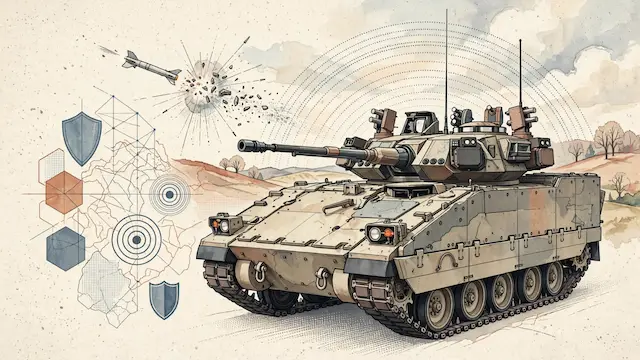
The U.S. Army has officially begun fielding its first Bradley fighting vehicles equipped with Israel's "Iron Fist" active protection system, manufactured by Elbit Systems. This deployment marks a significant operational step for the U.S. ground forces, aiming to counter modern battlefield threats including advanced anti-tank missiles, RPGs, suicide drones, and loitering munitions. This selection represents a major endorsement for the Israeli defense industry, as the U.S. military once again chooses Israeli technology to protect its soldiers.
The Bradleys receiving the Iron Fist system are not newly manufactured but existing vehicles that have undergone extensive upgrades to the M2A4 (specifically M2A4E1) standard. These upgrades include replacing the engine, transmission, and suspension, with a critical enhancement to the electrical systems to support the high power demands of the Iron Fist's electronics, radar, and interceptors. This modernization transforms older vehicles into more protected and survivable platforms.
The current procurement is part of a collaboration between Elbit Systems and American defense giant General Dynamics Land Systems (GDLS). Initial contracts are valued at over $200 million for equipping a full Armored Brigade Combat Team (ABCT), with the program's total potential reaching hundreds of millions more as procurement expands to additional brigades. The U.S. Army plans a gradual rollout and operational integration of these vehicles over the coming years, including combined training exercises.
The choice of Iron Fist for the Bradley highlights its technological differences from Rafael's Trophy system. While Trophy uses a dense blast fragmentation of metal pellets to neutralize threats, Iron Fist employs a smaller, expendable interceptor that explodes near the target, neutralizing it with a blast wave. This approach minimizes secondary fragmentation, reducing risk to infantry operating near the vehicle. Iron Fist's lighter and more compact design also makes it suitable for medium and light armored vehicles that cannot support the weight of Trophy.
Despite adopting Iron Fist for Bradleys, the U.S. Army continues to use Rafael's Trophy on its Abrams M1A2 tanks. However, lessons learned from the war in Ukraine have led the Pentagon to cancel the SEPv4 upgrade for Abrams in favor of a new M1E3 tank. The future tank will feature integrated active protection systems rather than external add-ons, with Rafael and its partner Leonardo DRS developing modular, lightweight versions. In Israel, both Trophy and Iron Fist are in use; Merkava tanks and Namer APCs use Trophy, while the lighter Eitan armored personnel carriers are being equipped with Iron Fist, albeit with delays due to budget priorities.
Mentioned
The same event, reported separately by each outlet. Open a few to compare what different newsrooms emphasize — and what they leave out.
Centre 2

Not the same event — other stories that share this one’s people, places, or theme: background, reactions, and follow-ups.