
Israel Loses Chance to Buy Apache Helicopters Amid Budget Dispute
Translated & summarized from Vesty by baba
Israel has lost its chance to purchase 12 Apache attack helicopters from the U.S. due to a budget dispute between the Ministries of Finance and Defense, failing to secure $288 million in funding. The deal, crucial for improving IAF response times after the October 7 attacks, collapsed after the U.S. denied a third extension. This failure also threatens other vital military procurements, including refueling and transport helicopters, as defense officials warn of production slot losses and increased costs. The ongoing inter-ministerial conflict over defense spending is impacting the IDF's readiness and ability to pay for existing orders.
The story in 6 lines · by baba
- Israel failed to order 12 Apache helicopters from the U.S. due to a $288 million funding dispute between ministries.
- The U.S. denied Israel a third extension, causing the $1 billion helicopter deal to collapse.
- The Apache purchase was intended to improve Israeli Air Force response times after the October 7 attacks.
- The failure jeopardizes other U.S. defense procurements, including refueling and transport helicopters.
- Defense officials blame the Finance Ministry, while the Finance Ministry cites changes in deal terms by the Defense Ministry.
- The dispute highlights broader conflicts over defense spending impacting IDF readiness and payments for existing orders.
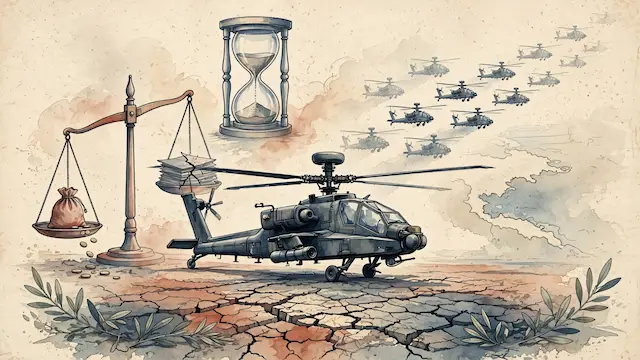
Israel has missed its final opportunity to order 12 Apache attack helicopters for the Israeli Air Force (IAF) from the United States, a deal estimated at approximately $1 billion. The failure to secure the purchase is attributed to a budget dispute between the Ministry of Finance and the Ministry of Defense, which could not agree on financing for roughly $288 million, one-third of the total cost. The U.S. extended the order deadline three times, but Israel failed to meet the final deadline, according to a report by Calcalist on October 8.
The acquisition of these helicopters was intended to address a critical need identified following the October 7, 2023 Hamas attack, highlighting the necessity for faster IAF response times. Despite a year of discussions involving the Ministry of Defense, Ministry of Finance, and the National Security Council, no resolution was reached, leading to the deal's collapse. A senior defense official told Calcalist that the U.S. had granted three extensions to allow Israel to finalize the matter, but it was ultimately unsuccessful.
This missed opportunity jeopardizes other urgent Israeli defense procurements from the U.S., including two additional Boeing KC-46 refueling aircraft and an increase in the order of Lockheed Martin CH-53K transport helicopters from 12 to 18. Defense officials had warned for months that delays could result in losing production slots, potentially delaying deliveries by years and significantly increasing costs. The Apache deal was structured as a government-to-government transaction, with the U.S. Department of Defense awaiting Israel's decision before placing a larger order with Boeing.
The Ministry of Defense blames the Ministry of Finance for the deal's failure, with one source suggesting the collapse occurred on October 7, the anniversary of the Hamas attack. The source stated that the Ministry of Finance "ran with this to the Ministry of Justice and sabotaged it." The Ministry of Finance, however, denies this, claiming the Ministry of Defense altered the deal's terms after initial approval, making it impossible to finance within legal budgetary constraints.
The helicopter purchase failure occurs amidst an ongoing conflict between the two ministries over defense spending. This dispute has also prevented the Ministry of Defense from paying over 17 billion shekels for existing orders from companies like Rafael, Elbit Systems, and Israel Aerospace Industries. Defense officials have warned that budget delays are critically impacting the IDF's readiness, with depleted ammunition and air defense missile stocks and difficulties in replacing destroyed vehicles. The situation is further complicated by potential production halts for certain military equipment and the inability of defense contractors to continue self-financing army production.
Mentioned
The same event, reported separately by each outlet. Open a few to compare what different newsrooms emphasize — and what they leave out.
Centre 1Other 4





Not the same event — other stories that share this one’s people, places, or theme: background, reactions, and follow-ups.

