
Israeli Forces Detain, Interrogate 95 Palestinians in West Bank Sweep
Translated & summarized from Arab48 by baba
Israeli forces detained or interrogated approximately 95 Palestinians in a sweep across the West Bank from Thursday night into Friday morning. The Palestinian Prisoners' Club reported that field interrogations were the most common, linking the operation to increased settler violence and land seizures. The raids, which included home invasions and property destruction, focused on several towns and cities. The club stated these actions are part of a broader Israeli control system and have escalated significantly since the war in Gaza began, with over 26,000 arrests in the West Bank since then.
The story in 5 lines · by baba
- Israeli forces detained or interrogated 95 Palestinians in a West Bank sweep overnight Thursday.
- The Palestinian Prisoners' Club linked the operation to rising settler attacks and land seizures.
- The sweep included raids on homes and focused on several West Bank towns and cities.
- Field interrogations constituted the majority of the cases, according to the Prisoners' Club.
- Over 26,000 Palestinians have been arrested in the West Bank since the war in Gaza began.
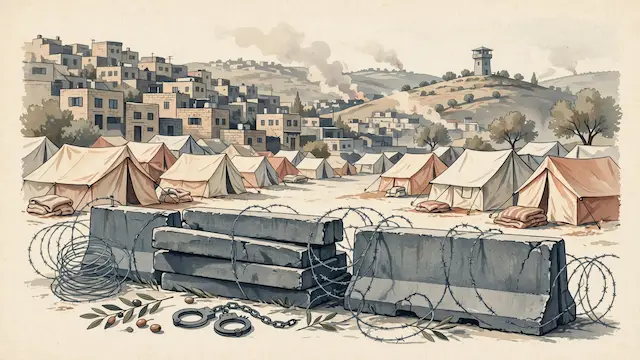
Israeli forces conducted a wide-ranging operation across the West Bank from Thursday night into Friday morning, detaining or subjecting approximately 95 Palestinians to field interrogations. The Palestinian Prisoners' Club stated that field interrogations constituted the majority of cases. The club linked the sweep to an increase in settler attacks and land seizures.
The operation focused on areas including Aqaba in Tubas Governorate, Madama south of Nablus, Yatta in southern Hebron, as well as Jenin, Bethlehem, and al-Bireh. In Qalqilya, the arrests included released prisoners and relatives of current detainees, such as the mother of a released prisoner and the wife of a detainee. Israeli forces also raided dozens of homes, including that of Mu'ayyad Sha'ban, head of the Wall and Settlement Resistance Commission.
According to the Prisoners' Club, the raids and interrogations were accompanied by extensive vandalism and destruction of property, along with assaults on Palestinians. The club asserted that the campaign is inseparable from the escalating settler violence against Palestinian towns and villages, particularly during the olive harvest season, which often sees attacks on residents, their land, and property, and prevents access to agricultural areas. These attacks, the club noted, occur alongside land confiscation and settlement expansion, with detention and field interrogation serving as tools for control.
The Palestinian Prisoners' Club emphasized that these mass arrests and field interrogations are part of a broader system of control, aimed at terrorizing citizens, asserting dominance over Palestinian communities, and undermining their ability to resist occupation and settlement policies. The club connected these actions to other Israeli practices, including torture, home demolitions, property destruction, and extrajudicial killings, viewing them as interconnected elements of Israeli aggression.
These practices, the club added, cannot be separated from the war in Gaza, noting that while detention and repression are not new, they have seen an unprecedented escalation in scope, intensity, and violence since the war began. The intensification of arrests and field interrogations in the West Bank coincides with accelerated settlement activity and settler attacks, making detention a tool for reshaping the ground reality and imposing further control.
Palestinian institutions report that over 26,000 Palestinians have been arrested in the West Bank since the start of the war in Gaza, in addition to thousands arrested in Gaza itself. The Prisoners' Club cited an Israeli announcement of 46,000 arrests and interrogations in the West Bank since the war began, a figure that includes field interrogations. The club called on the international community and human rights organizations to act to stop these systematic practices and hold Israel accountable.
Mentioned
The same event, reported separately by each outlet. Open a few to compare what different newsrooms emphasize — and what they leave out.
Arab 2

Not the same event — other stories that share this one’s people, places, or theme: background, reactions, and follow-ups.
