
Houthis Seize Key Yemen Strait After World Leaders Ignored Warnings
Translated & summarized from Maariv by baba
The Houthi militia has seized the vital Bab el-Mandeb strait in Yemen, capturing approximately 4,660 square kilometers of territory after a swift overnight offensive. This strategic gain occurred despite prior warnings to Saudi Arabia and the United States, which failed to act decisively. Saudi Arabia has now launched a renewed bombing campaign with U.S. support to reclaim the territory, though the long-term success is uncertain. The Houthi victory highlights their growing military capabilities and the fragmentation of the Yemeni government forces.
The story in 6 lines · by baba
- Houthi forces captured approximately 4,660 square kilometers of territory, reaching the Bab el-Mandeb strait.
- Saudi Arabia launched a renewed bombing campaign with U.S. intelligence to help Yemen reclaim lost territory.
- General Saleh had warned allies in Saudi Arabia and the U.S. about the growing Houthi threat but received little support.
- The Houthi takeover occurred over a single night of chaos after government communication systems were severed.
- A Houthi official dismissed Saudi forces as "mercenaries" fighting to "liberate Yemen from occupation."
- The Yemeni government is described as a "fiction," more focused on internal fighting than confronting the Houthis.
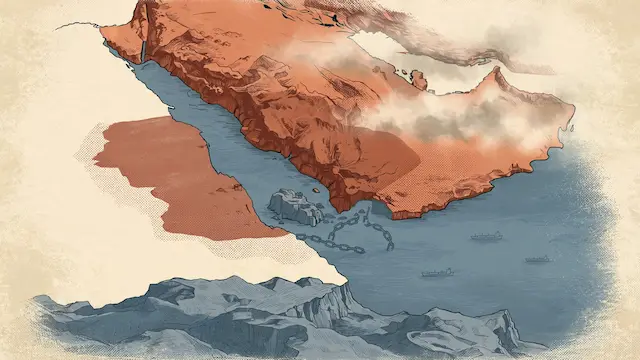
The Houthi militia has captured approximately 4,660 square kilometers of territory in Yemen, reaching the critical Bab el-Mandeb strait, despite prior warnings. The swift takeover, which occurred over a single night of chaos and confusion, has plunged Yemen back into a war with global implications. Saudi Arabia has since launched a renewed bombing campaign, with U.S. intelligence and targeting assistance, to help the Yemeni government reclaim the lost territory. As of Tuesday, government forces claimed significant progress and had encircled Houthi fighters at the strait, though the long-term success of this counteroffensive remains uncertain.
According to a New York Times investigation, General Saleh had attempted to alert influential allies in Saudi Arabia and the United States about the growing Houthi threat. With about 10% of global trade passing through the Bab el-Mandeb strait, both nations had a vested interest in preventing an Iran-aligned militia from gaining a strategic foothold. However, their inaction allowed the Houthis to achieve this critical objective, forcing a panicked retreat by their adversaries.
Despite Saudi Arabia's commitment to help "eliminate" the Houthis, a similar campaign a decade ago devolved into a bloody quagmire. A Houthi official, Mohammed al-Bukhaiti, attributed their victory to years of military advancement, dismissing Saudi forces as "mercenaries" fighting to "liberate Yemen from occupation."
The New York Times report, based on interviews with dozens of officials and fighters, highlights how the previously disorganized Houthi militia has transformed into a formidable force with advanced technology. This defeat is seen as a significant blow to the Yemeni government and its Saudi patrons, exposing deep divisions within the Yemeni military. U.S. intelligence had repeatedly warned Saudi Arabia about the escalating Houthi threat and urged them to unify the fragmented Yemeni government forces. General Saleh's requests for Saudi air support and U.S. electronic warfare assistance were largely ignored.
The collapse began on September 9th when government communication systems were completely severed. Soldiers reported losing contact amidst widespread Houthi advances, leading to a chaotic retreat. The Yemeni civil war, which has already caused hundreds of thousands of deaths, saw the Houthis improve their military capabilities during a 2022 ceasefire while the government weakened. Experts describe the current Yemeni government as a "fiction," more focused on internal infighting than on fighting the Houthis.
General Saleh, who had previously allied with the Houthis before joining the government, built a force of about 50,000 fighters. However, the withdrawal of UAE support in January left him solely under Riyadh's patronage. Following U.S. and Israeli actions against Iran in February, the Houthis initiated attacks on Saudi territory and blockaded ships in the Red Sea, aligning with Iran's strategy to broaden the conflict. In August, the Houthis began shelling Mocha to cut off supply lines and launched a ground offensive, exploiting mistrust among Yemeni army factions to breach defenses. Many government soldiers reportedly abandoned their weapons and fled, with one soldier describing fleeing government vehicles "speeding past us like bullets."
After Mocha's fall, General Saleh and his associates fled to Riyadh, while their remaining troops in Yemen are scattered and some are stranded without food. An officer close to Saleh stated that their focus is now on reorganization and treating the wounded, with a comprehensive investigation into the failure planned.