Israel Establishes Memorials to October 7th Massacre
Translated & summarized from Davar by baba
The story in 5 lines · by baba
- Israel is creating multiple memorial sites for the October 7th massacre.
- Exhibits range from detailed museums with artifacts to therapeutic installations.
- The sites aim to preserve memory and detail Hamas's motives and actions.
- Challenges include societal division and the potential for a one-sided narrative.
- The future of some open-air memorials remains uncertain.
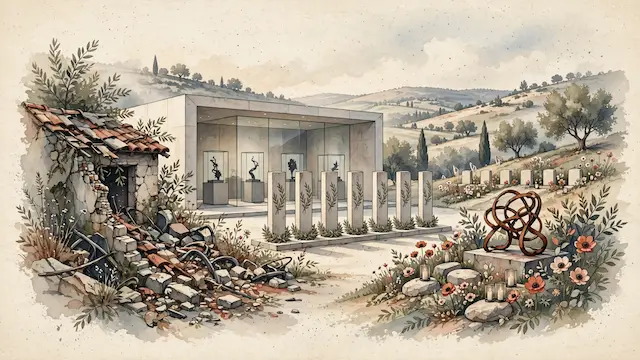
Israel is in the early stages of memorializing the October 7th massacre, with various institutions and organizations taking the initiative to create sites and exhibits. The article visits several of these, highlighting the complex and often contested nature of memory in a deeply divided society, especially in the absence of a unified national investigation.
The "Shuva Ba'October" museum near Glilot, largely unknown to the public, is described as the most comprehensive and in-depth exhibit on the massacre. It houses artifacts like Sinwar's vest, weapons, Hamas documents, and propaganda materials, aiming to detail the events and Hamas's ideology and planning. The exhibit emphasizes the premeditated and brutal nature of the attack, including evidence of Hamas's indoctrination and use of civilian infrastructure. However, the article notes a potential one-dimensional portrayal by omitting internal conflicts within jihadist movements and the broader societal divisions.
The "Mikan Nakum" (From Here We Will Rise) installation on the Azrieli Center rooftop in Tel Aviv offers a more therapeutic and unifying experience. It combines poetry by Noam Horovitz and photographs by Ziv Koren, focusing on themes of resilience, national unity, and recovery over the past three years, rather than graphic details of the massacre itself. While accessible and emotionally resonant, the article suggests it may gloss over the full complexity and trauma of the events, potentially leading to a forgotten narrative if it becomes the sole form of national remembrance.
The site of burnt-out vehicles in Tekuma, initially a chaotic collection point for identifying victims and missing persons, has evolved into a somber memorial. Guided tours recount the stories of those who perished or were abducted, highlighting the perpetrators' actions, including the deliberate burning of vehicles to impede escape. The site also displays vehicles used by Hamas attackers. The future of this open-air memorial, exposed to the elements, remains uncertain.
An exhibit by the Israel Antiquities Authority, "Tekuma Min Ha'afar" (Resurrection from the Dust), focuses on the harrowing work of archaeologists in identifying victims and documenting massacre sites. Using archaeological methods, they located remains in devastated areas and created detailed 3D virtual models of destroyed homes and shelters. The article also touches upon the "October 7th Center" in Sderot, which uses original video footage and VR experiences to recount the events, and the Nova massacre site at Re'im, which has become a national temporary memorial with personal tributes and organized sections dedicated to victims and first responders.
Finally, the 7/10 Museum in Haifa, located within the Holocaust Museum, draws a direct parallel between the massacre and the Holocaust, displaying personal items and artwork. The Nova massacre site at Re'im is described as a developing national memorial, evolving from spontaneous tributes to a more organized and respectful space for remembrance, focusing on individual stories and collective grief without politicization.
Mentioned