
Israeli Scientists Develop "Super Ice" Ten Times Stronger Than Regular Ice
Translated & summarized from Mignews by baba
The story in 6 lines · by baba
- Israeli scientists created a new material called BioPykrete from ice.
- BioPykrete is ten times stronger and more fracture-resistant than regular ice.
- The material uses cellulose nanocrystals and an engineered protein as a "molecular glue."
- Its compressive strength is comparable to concrete.
- The research was led by Professor Ido Braslavski at the Hebrew University.
- Further testing is needed for durability and construction applications.
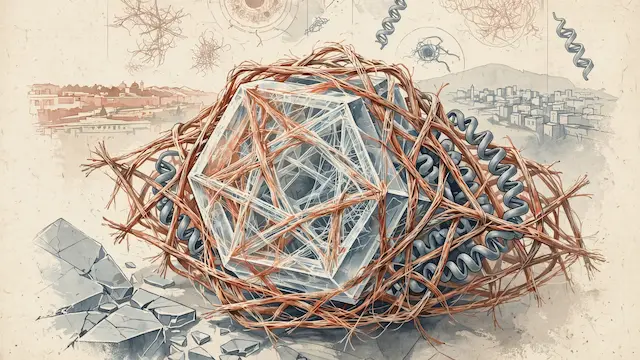
Researchers at the Hebrew University of Jerusalem have created a novel material called BioPykrete, which is approximately ten times stronger and significantly more resistant to fracture than ordinary ice. According to the scientists, the composite can absorb about 70 times more energy before breaking. The findings were published in the journal Colloids and Surfaces B: Biointerfaces.
BioPykrete is composed of ice, plant-derived cellulose nanocrystals, and a specially engineered protein that acts as a "molecular glue." This protein binds the cellulose particles to the ice, facilitating the formation of an internal three-dimensional structure that slows the propagation of cracks. Consequently, the material fractures gradually, and its compressive strength is comparable to that of standard concrete.
The addition of the engineered protein reportedly doubled the strength and energy absorption capabilities compared to a mixture of ice and cellulose without the protein. Professor Ido Braslavski from the university's Faculty of Agriculture, Food and Environment led the study. He explained that the goal was not merely to add fibers to ice but to control component interactions at the molecular level.
While the concept of reinforcing ice, such as the World War II-era "pykrete" (ice and sawdust), is not new, the Israeli researchers have advanced this principle using nanomaterials and protein engineering. BioPykrete is currently an experimental development. Future research will focus on assessing its durability, resistance to freeze-thaw cycles, and suitability for construction and infrastructure in Arctic and other extremely cold regions.

