
Israel's Electric Vehicle Market Faces Steep Decline Without Incentives
Translated & summarized from Maariv by baba
Israel's Ministry of Energy warns that electric vehicle sales could drop to 10% by 2030 without government incentives and charging infrastructure investment, citing a current sharp decline in market penetration. The ministry proposes legislative and financial measures to reverse the trend, highlighting potential economic benefits and consumer savings.
The story in 6 lines · by baba
- EV sales in Israel may fall to 10% by 2030 without intervention.
- Current EV penetration has dropped significantly to 12% in early 2026.
- Ministry of Energy urges incentives and charging infrastructure investment.
- Finance Ministry reportedly favors fuel taxes over EV promotion.
- Economic losses from EV slowdown estimated at billions of shekels.
- Consumers could save NIS 70,000 over a vehicle's lifetime.
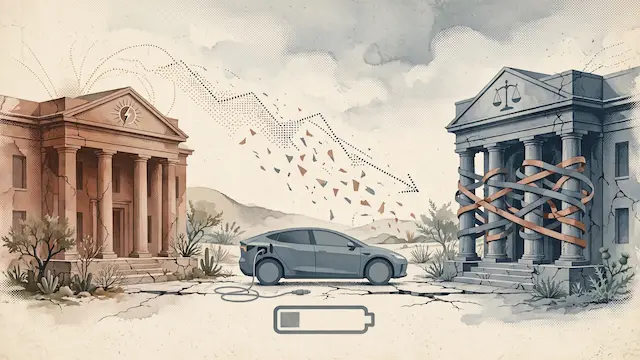
Israel's electric vehicle (EV) market is experiencing a significant slowdown, with the Ministry of Energy warning that EV sales could plummet to as low as 10% by 2030 if incentives and charging infrastructure investments are not implemented. The current penetration rate has already dropped considerably, falling from approximately 25% of new car sales in 2024 to about 20% in 2025, and standing at just 12% in the first half of 2026.
A mid-range scenario, assuming continued government support, projects EV sales reaching around 40% by 2030. However, the Ministry of Energy appears to be the sole government body actively promoting this transition, while the Ministry of Finance reportedly prioritizes revenue from traditional fuel taxes and congestion charges over EV adoption. This delay in EV growth is estimated to cause economic losses of NIS 0.6 to 2.2 billion in 2027 alone.
The Ministry of Energy has outlined key measures to overcome these obstacles, including legislative frameworks and incentives for charging stations in shared residential buildings, long-term regulatory and tax certainty for drivers, and encouraging rental fleets to switch to EVs. The ministry emphasizes that consistent and active policy is crucial to regaining high EV penetration rates and achieving significant economic benefits, estimated at tens of billions of shekels, while also reducing living costs for millions of citizens.
Other government ministries are not actively engaged or are in opposition to the EV transition. The Ministry of Transportation is not involved, the Ministry of Finance is described as resistant and dismissive, the Prime Minister's Office lacks coordinated policy efforts, and the Ministry of Environmental Protection has limited authority. The Ministry of Energy acknowledges the continued existence of oil refineries, explaining it as a measure to ensure energy security and fuel market stability until electric transportation targets are met.
Consumers stand to benefit significantly, with an estimated lifetime savings of NIS 70,000 per average driver due to lower energy and maintenance costs. The Ministry of Energy warns that without a substantial policy package to encourage EV adoption and charging infrastructure development, Israel risks having one of the lowest EV penetration rates among developed nations.
Mentioned
The same event, reported separately by each outlet. Open a few to compare what different newsrooms emphasize — and what they leave out.
Centre 4Other 1





Not the same event — other stories that share this one’s people, places, or theme: background, reactions, and follow-ups.
