
Hostage Survivor Yarden Bibas Appeals Nir Oz Kibbutz Decision to Demolish His Home
תומצת מתוך Haaretz על ידי baba
Yarden Bibas, a hostage survivor, is appealing Kibbutz Nir Oz's decision to demolish his family home, which was damaged during the October 7th attack. The kibbutz narrowly voted to dismantle "structures of testimony" and create an external memorial, repurposing Bibas's house. Bibas shared emotional memories of his family in the home, calling it a crucial testament to the massacre and the lives lost. The decision reflects an ongoing debate within the kibbutz between those prioritizing rebuilding and those wishing to preserve the homes as historical evidence.
הידיעה ב-5 שורות · תקציר של baba
- Yarden Bibas, a hostage survivor, opposes Kibbutz Nir Oz's plan to demolish his family home.
- The kibbutz narrowly voted to dismantle "structures of testimony" for an external memorial.
- Bibas described his home as the last tangible memory of his murdered wife and sons.
- The decision to demolish homes has divided the Nir Oz community since October 7th.
- Many survivors and bereaved families want to preserve houses as testimony to the massacre.
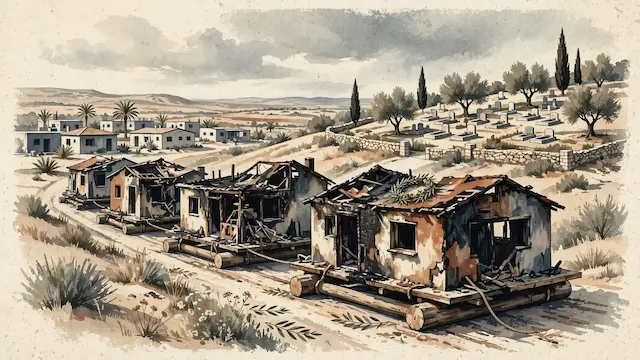
Yarden Bibas, a survivor of Hamas captivity, has appealed to the members of Kibbutz Nir Oz to reconsider their decision to demolish homes damaged during the October 7th massacre, including the one from which his family was abducted. Bibas expressed his anguish on Facebook, stating that the kibbutz's decision to destroy his home is "tormenting and crushing" him. The kibbutz assembly narrowly approved a plan to dismantle all "structures of testimony" and reconstruct parts of them in an external memorial complex. Under this alternative, Bibas's family home would be repurposed by the kibbutz.
The vote saw 38 out of 75 members (51%) support the demolition plan, just above the required majority. Another 32 members (43%) favored preserving most homes in place and developing Bibas's house as a "living heritage site," while five opposed both options. Bibas, whose wife Shiri and sons Ariel and Kfir were murdered in captivity, shared poignant memories of his family's life in the house, noting that Ariel learned to walk and talk there, and Kfir spent his first months of life there.
He described the house as the last place he saw his family happy and emphasized its significance as a testament to the events of October 7th, the lives that were lived, and those brutally cut short. Bibas argued against erasing the past in the name of rehabilitation and growth, stating that a future can be built without destroying all remnants of the past. He acknowledged the desire for the kibbutz to flourish again but stressed that this should not come at the expense of historical testimony.
The kibbutz faced a dilemma for months regarding the fate of the burnt houses. Hamas terrorists entered almost all homes in Nir Oz on October 7th, resulting in 123 residents, foreign workers, and members being killed or abducted. Many active kibbutz members who returned to the community supported demolition, believing normal life is impossible among burnt structures. Conversely, survivors, massacre witnesses, and bereaved families advocated for preserving the houses as evidence.
In August, hostage survivor Gadi Moses stated, "This will not be a museum here," while Ofri Bibas, Yarden's sister, called the house "the last remnant, the most tangible memory of what was." To prevent community division, kibbutz members had previously agreed to leave certain sensitive houses standing as "waiting areas" until a decision could be made. The kibbutz has since demolished dozens of old, burnt structures and begun developing new neighborhoods and public buildings. The dispute has narrowed to three areas, including the site where three members of the standby unit fell in battle, and two areas containing five houses, including those of the Bibas and Kedem Siman Tov families, where parents Tamar and Johnny and their children Shahhar, Arbel, and Omer were murdered.
להמשיך לעקוב
מוזכרים
אותו אירוע, כפי שכל מערכת דיווחה עליו בנפרד. פתחו כמה דיווחים כדי להשוות מה כל מערכת מדגישה, ומה היא משאירה בחוץ.
שמאל 1מרכז 2



לא אותו אירוע: ידיעות אחרות שחולקות עם הידיעה הזו אנשים, מקומות או נושא. רקע, תגובות והמשכים.
