
Families Endure Agonizing Wait for Bodies of Slain Relatives Held by Israel
תורגם ותומצת מתוך Arab48 על ידי baba
Hundreds of Palestinian families are waiting for the return of bodies of relatives killed by Israeli forces or settlers, with Israel detaining at least 807 bodies. The practice, intensified in recent years, is seen by families as a form of collective punishment and by Israel as a bargaining tool for prisoner exchanges. Families like those of Nidal Shaghnoubi, Mu'taz Daghlis, and Wisam Ishtayeh have endured waits of months to over a year for the return of their loved ones' remains, facing immense emotional distress.
הידיעה ב-6 שורות · תקציר של baba
- Israel is detaining at least 807 bodies of Palestinians, causing prolonged distress for hundreds of families.
- Families are waiting months to years for the return of bodies of relatives killed by Israeli forces or settlers.
- The policy of detaining bodies is viewed by families as collective punishment and by Israel as a bargaining tool.
- The practice of holding bodies has intensified in recent years, extending to civilians.
- Families describe the wait as agonizing, marked by uncertainty, grief, and clinging to hope.
- The Jerusalem Center for Legal Aid and Human Rights reported the number of detained bodies.
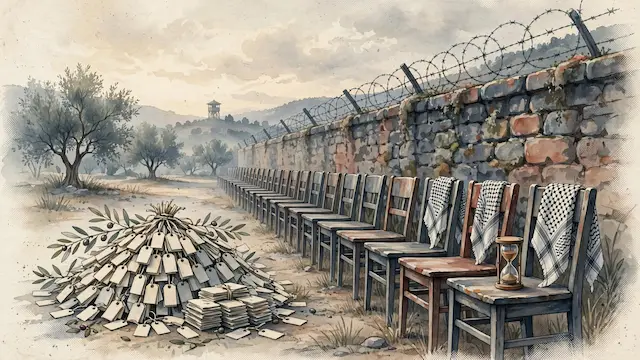
Hundreds of Palestinian families in the West Bank and Gaza Strip are enduring prolonged and agonizing waits for the return of the bodies of their loved ones, who were killed by the Israeli army, settlers, or died in Israeli custody. The Israeli authorities are holding these bodies, a practice that has intensified in recent years, leaving families in a state of uncertainty and deep distress.
Wael Shaghnoubi has been waiting for a year and a half for the body of his 16-year-old son, Nidal, who was shot by Israeli soldiers near the village of Burqa. Shaghnoubi recounts that soldiers took his son's body and prevented anyone from approaching, leaving him in a state of constant worry and clinging to hope. The Israeli military claimed that Nidal and two other youths were throwing stones at vehicles, prompting soldiers to open fire. Despite indirect notification of his son's death, Shaghnoubi holds onto hope, citing a past instance where the army misidentified a body, and the declared deceased was later found alive and imprisoned.
According to the Jerusalem Center for Legal Aid and Human Rights, Israel is currently detaining 807 bodies of Palestinians, including 678 from the West Bank and 105 from Gaza. Hussein Shujaia, coordinator of the "National Campaign to Retrieve Detained Martyrs' Bodies and Reveal the Fate of the Missing," stated that hundreds more bodies of Palestinians killed during the "genocidal war in Gaza" since 2023 have not yet been properly documented.
Israel's policy of detaining bodies is seen as a systematic tactic to use them as bargaining chips. In 2017, the Israeli Security Cabinet decided that some bodies could be held for prisoner exchange deals. Initially applied to Hamas members or "operatives," this policy has since expanded to include civilians.
Iyad Daghlis, 52, is waiting for the body of his 14-year-old son, Mu'taz, killed by Israeli forces a week prior. He expressed the difficulty of the situation, stating, "They kidnapped the body." Mu'taz was killed during confrontations where the Israeli army alleged the youths were throwing stones at vehicles. Daghlis's son carries the name of his uncle, who was also killed by Israeli forces in similar circumstances in 2001 and whose body was held for three days. Daghlis notes that the current detention periods can extend to years.
In November, the Ishtayeh family in the village of Salem received the body of their son, Wisam, 36, after a year and a half of detention. Wisam was killed in July 2025 during confrontations following an army raid. His father, Ghassan Ishtayeh, shared that the family had clung to the belief that Wisam was injured and hospitalized, living in constant anxiety until the news of his death was confirmed.
להמשיך לעקוב
מוזכרים