
Gaza Winter Exposes Shelter, Resource Management Failures Amidst Crisis
תורגם ותומצת מתוך Alarab על ידי baba
Winter in Gaza presents a severe challenge for war-affected residents, with damaged shelters and a lack of essential supplies like heating and warm clothing. A significant funding gap of $186.6 million exists for winter aid, and over 150,000 humanitarian-purchased tents remain outside the Gaza Strip. Authorities face criticism for the gap between announced aid and actual delivery, highlighting failures in resource management and distribution amidst ongoing restrictions.
הידיעה ב-6 שורות · תקציר של baba
- Winter in Gaza exacerbates the suffering of war-torn residents, testing their shelter and resource management capabilities.
- Over 40,000 shelters were damaged by recent rains, affecting approximately 46,000 families.
- A severe funding gap of $186.6 million exists for essential winter aid, with only 35% of needs met.
- More than 150,000 humanitarian-purchased tents are held outside Gaza, awaiting delivery.
- The crisis highlights a critical gap between aid availability and its actual distribution to needy families.
- Effective coordination, fair distribution, and transparency are crucial for managing the ongoing crisis.
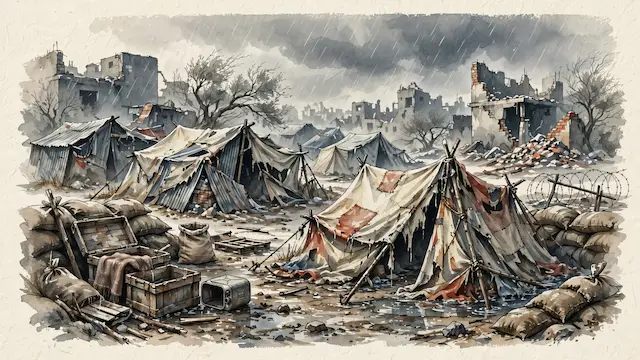
Winter in Gaza presents a severe challenge for residents already devastated by war, testing their ability to find shelter and manage resources. Heavy rains, which bring relief elsewhere, pose a direct threat to families living in tents and inadequate shelters lacking basic protection. Securing heating, clothing, and blankets is difficult due to diminished purchasing power and supply shortages.
The core issue is not just the scale of Gaza's winter needs but the capacity of relevant authorities to translate known requirements into effective action. A significant gap exists between announced aid and what actually reaches families facing the cold and rain. Recent rains damaged over 40,000 shelters and affected approximately 46,000 families, with more than 9,000 shelters deemed irreparable. Around 1.98 million people require shelter and essential supplies.
Beyond a lack of tents, the crisis highlights the growing number of families without safe housing. Tents alone are insufficient without insulation, bedding, blankets, and winter clothing. Safe and continuous energy sources are also needed for heating. Humanitarian organizations warn that shortages and high costs of cooking gas and firewood force families into difficult choices, while those who lost income cannot afford to supplement aid from markets.
The winter response faces a severe funding shortfall, with only 35% of the estimated $283.2 million needed for winter aid secured, leaving a $186.6 million gap. Available stock covers less than 20% of estimated needs for items like blankets and lighting, and less than 1% for winter clothing.
Compounding the funding crisis is the stalled delivery of aid. The UN reports over 150,000 tents purchased by humanitarian groups and member states remain outside Gaza, including about 117,000 from the Egyptian Relief Committee in Al-Arish. This situation underscores that aid availability does not guarantee delivery to those in need, especially with ongoing restrictions on entry, funding shortages, and access complexities.
Effective coordination, updated databases to identify vulnerable families, and fair distribution are crucial for protecting residents. Transparency regarding stock levels, incoming aid, and distribution is essential to build trust and allow for outcome-based assessments. Preparations must also include water drainage, debris removal, sewage system maintenance, and providing more sustainable housing solutions than damaged tents. Addressing the winter crisis requires efficient management, prioritization, and accountability, not just aid distribution.
לא אותו אירוע: ידיעות אחרות שחולקות עם הידיעה הזו אנשים, מקומות או נושא. רקע, תגובות והמשכים.

