
US Pilots Reveal Dramatic Details of Secret Iran Nuclear Facility Bombing
US B-2 bomber pilots have detailed the June 2025 strike on Iran's Fordow nuclear facility, Operation Midnight Hammer. The 37-hour mission involved seven stealth bombers dropping 13.6-ton bombs, creating a massive explosion. Israeli airstrikes beforehand were credited with making the US mission safer. The operation faced last-minute plan changes and secrecy challenges, with pilots enduring extreme fatigue during the flight.
הידיעה ב-6 שורות · תקציר של baba
- US B-2 bombers struck Iran's Fordow nuclear facility in June 2025 during Operation Midnight Hammer.
- The mission lasted nearly 37 hours and involved seven stealth bombers dropping 13.6-ton bunker-buster bombs.
- Israeli airstrikes in Iran were credited by US pilots with making the American mission significantly safer.
- The US operation faced last-minute plan changes due to Iran's efforts to protect the Fordow facility.
- Pilots endured extreme fatigue and relied on short naps and stimulants during the long flight.
- Secrecy was maintained through a decoy operation involving other bombers flying in a different direction.
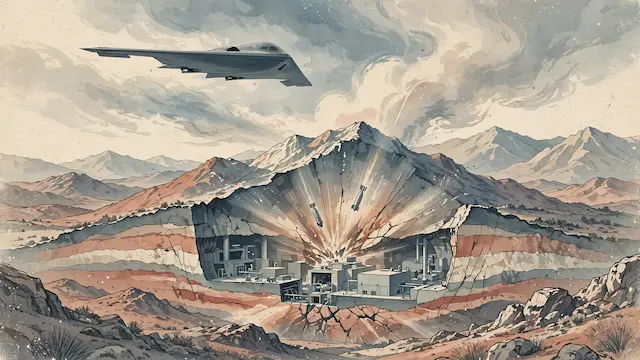
American B-2 bomber pilots have revealed for the first time the intense moments of the June 2025 strike on Iran's Fordow nuclear facility, codenamed Operation Midnight Hammer. The mission, which lasted nearly 37 hours and involved seven stealth bombers, was a highly complex operation requiring extensive planning and coordination.
Pilots described the 18-hour flight from Whiteman Air Force Base in Missouri, the immense power of the two 13.6-ton bunker-buster bombs they dropped, and the dramatic fireball that rose ten stories high upon detonation. The mission's target was the uranium enrichment facility at Fordow, located underground southwest of Tehran. Preparations for the strike began as early as 2009, with American intelligence gathering data on the facility for 15 years.
One of the key pilots, identified as "Alpha," credited Israeli airstrikes in Iran prior to the US operation with significantly clearing threats and making the mission safer. He described the Israeli actions as a "masterclass in Western airpower" that demonstrated how to attack specific targets to gain air superiority. Despite this, the US plan underwent last-minute changes due to Iran's attempts to cover the facility's ventilation shafts with concrete, requiring the first bombs to breach this new layer before subsequent ones could penetrate the underground complex.
Maintaining secrecy was paramount. To mislead observers, decoy bombers flew openly westward while the seven actual strike aircraft departed eastward, crossing the Atlantic, Mediterranean, and Middle East. Pilots endured extreme fatigue during the long flight, relying on short naps, coffee, and energy drinks. One pilot, "Bravo," humorously activated his inflatable life vest inside the cockpit, creating a comical scene.
As the bombers approached Iran, they faced anxieties about air defense systems, though no missiles were fired. The mission involved six bombers targeting Fordow and a seventh heading to the Natanz facility, which had previously been attacked by Israel. After successfully delivering their payloads, the pilots faced the tense egress from Iranian airspace. Upon their return, they discovered President Donald Trump had already publicly announced the strike, turning their secret mission into a global headline.
מוזכרים




