
World Court Rules Myanmar Committed Genocide Against Rohingya
The International Court of Justice ruled that Myanmar committed genocide against the Rohingya Muslim minority, marking a historic first. The court ordered Myanmar to allow the safe return of refugees, provide reparations, and punish perpetrators. The decision follows a 2019 case brought by Gambia and addresses widespread violence and killings during a 2017 military operation. The ruling may influence other international legal proceedings, including the case against Israel concerning Gaza.
הידיעה ב-6 שורות · תקציר של baba
- The ICJ ruled Myanmar committed genocide against the Rohingya, a historic first for the court.
- Myanmar's security forces killed thousands, committed sexual violence, and attacked fleeing civilians in 2017.
- The court ordered Myanmar to allow refugee returns, provide reparations, and punish those responsible.
- Gambia initiated the case in 2019, alleging violations of the Genocide Convention.
- The ruling could impact other international legal cases, including South Africa's case against Israel.
- Rohingya activists hailed the decision as a major victory for the oppressed.
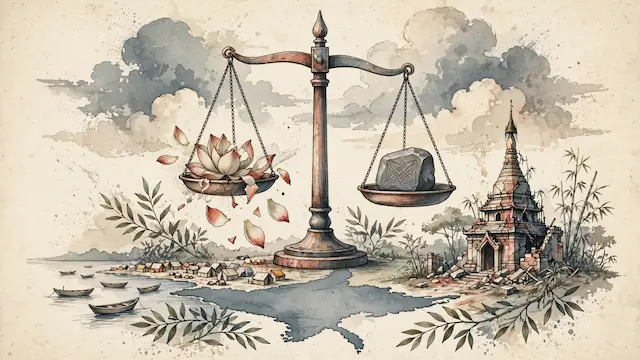
The International Court of Justice (ICJ) in The Hague ruled on Thursday that Myanmar committed genocide against the Rohingya Muslim minority. This marks the first time the court has determined a country is responsible for committing genocide, rather than just failing to prevent it. The ruling, which concluded a seven-year legal process initiated by Gambia in 2019, found that Myanmar's security forces killed thousands of civilians, committed widespread sexual violence, and attacked children and fleeing civilians during a 2017 military operation. The court's judges were convinced that Myanmar acted with the intent to destroy a substantial part of the Rohingya population, with evidence suggesting approximately 10,000 Rohingya were killed.
In its legally binding decision, the ICJ ordered Myanmar to allow the safe and dignified return of displaced Rohingya, facilitate family reunification, and provide reparations and compensation to victims. This includes returning or replacing property and ensuring the physical and psychological rehabilitation of those affected. The court also mandated that Myanmar investigate the genocide and punish those responsible, with compensation amounts to be determined later. While the ruling is final and not subject to appeal, the ICJ lacks an independent enforcement mechanism.
The case was brought by Gambia in November 2019, alleging that Myanmar's military operation violated the 1948 Genocide Convention. Human rights activists and Rohingya representatives hailed the decision as a significant victory. "This is a big day for the Rohingya people, and a big day for all oppressed people in the world," said Yasmin Ullah, a Rohingya human rights activist present at the hearing.
The Rohingya, an ethnic Muslim minority in Buddhist-majority Myanmar, have faced systematic discrimination and statelessness for decades. The 2017 military operation in Rakhine State, launched after attacks by a Rohingya armed group, escalated into widespread violence, including mass killings, rape, and arson, leading to over 730,000 Rohingya fleeing to Bangladesh. Myanmar has consistently denied the allegations, with its former leader Aung San Suu Kyi defending the military's actions in 2019.
The ruling's implications extend beyond Myanmar, potentially influencing other cases before the ICJ, including South Africa's genocide case against Israel concerning Gaza. A key legal issue in both cases is proving genocidal intent, which requires demonstrating a specific intent to destroy a protected group. The ICJ's finding of intent in the Myanmar case, based on patterns of violence and destruction, could shape how future evidence is examined, though each case is judged on its own merits.
מוזכרים
אותו אירוע, כפי שכל מערכת דיווחה עליו בנפרד. פתחו כמה דיווחים כדי להשוות מה כל מערכת מדגישה, ומה היא משאירה בחוץ.
שמאל 1מרכז 9ימין 1חרדית 2ערבית 2אחרים 2




















לא אותו אירוע: ידיעות אחרות שחולקות עם הידיעה הזו אנשים, מקומות או נושא. רקע, תגובות והמשכים.
