
IDF Destroys Hamas Tunnel in Gaza, Citing Direct Threat
תורגם ותומצת מתוך Vesty על ידי baba
The IDF and Shin Bet destroyed a Hamas tunnel near Nuseirat in central Gaza on November 19, citing it as a direct threat and a ceasefire violation. Hamas condemned the action and appealed for international intervention. A report by the U.S.-backed Peacekeeping Council accused both Israel and Hamas of failing to uphold ceasefire commitments, noting a stalled peace process and ongoing tensions. The IDF stated it would continue to disrupt Hamas's military rebuilding efforts, while Hamas is reportedly working to restore its capabilities.
הידיעה ב-6 שורות · תקציר של baba
- IDF and Shin Bet destroyed a Hamas infiltration tunnel in central Gaza on November 19.
- Hamas condemned the tunnel destruction as a ceasefire violation and sought international intervention.
- A U.S.-backed council report accused Israel and Hamas of failing to uphold ceasefire commitments.
- The report noted a stalled peace process and ongoing tensions in the Gaza Strip.
- Israeli security sources warned Hamas is rebuilding military capabilities while global attention is elsewhere.
- The IDF confirmed eliminating several Hamas commanders in recent targeted strikes.
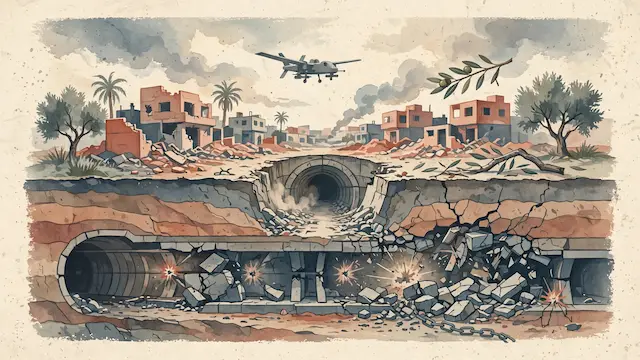
The Israel Defense Forces (IDF) and the Shin Bet security agency conducted an operation in central Gaza starting November 18 to destroy a Hamas infiltration tunnel. On November 19, the IDF announced that forces from the 162nd Division, along with armored and engineering units and Shin Bet agents, had destroyed a tunnel near the Nuseirat refugee camp that Hamas was preparing to use against Israeli forces. The previous day, Israel's Coordinator of Government Activities in the Territories (COGAT) had warned Palestinians to stay away from the operation area.
Hamas condemned the Israeli action as a "gross violation of the ceasefire" and appealed to mediators, including U.S. President Donald Trump, to intervene and halt what it called the "forced eviction of Palestinians." The IDF stated the tunnel posed an immediate threat and its activation constituted a violation of the ceasefire agreement, necessitating its immediate neutralization. This operation highlights rising tensions in Gaza, following Israeli security sources' warnings on November 16 that Hamas was rebuilding its capabilities while international attention was focused on Iran. These efforts reportedly include exploiting humanitarian facilities like hospitals for military purposes and restoring damaged underground infrastructure.
Meanwhile, the Peacekeeping Council, an initiative by President Trump to manage Gaza, accused both Israel and Hamas of failing to uphold their ceasefire commitments in a 12-page report submitted to the UN Security Council. The report, expected to be discussed by the Security Council before the end of November, noted a "serious gap between agreements and the reality on the ground," stating that a ceasefire yielding no tangible results cannot last indefinitely. The council acknowledged that Trump's peace plan for Gaza is stalled, with Hamas not disarming and reconstruction efforts yet to begin.
According to Reuters, Hamas had agreed in principle to the council's "roadmap" in July, but Israel rejected it in early August due to Hamas's failure to disarm. The report, however, presented a different view, suggesting that "every new Israeli attack pushes Hamas's agreement to the roadmap further away," and that "armed activity continues, while civilians face winter in tents and ruins." The council also criticized Israel for a lack of solutions to deploy Palestinian civil police to replace Hamas and for restrictions on the import of equipment and goods, hindering winter preparations.
The IDF reiterated its commitment to preventing any aggressive actions by Hamas and vowed to destroy any similar infrastructure discovered. Israeli security services are closely monitoring Hamas's attempts to restore its tunnel network and military potential, emphasizing the need for immediate disruption. The IDF is intensifying efforts to dismantle terrorist infrastructure alongside targeted assassinations, aiming to prevent Hamas from exploiting the fragile calm to rebuild its strength. Hamas, far from disarming, is actively recreating its military capabilities.
The article also detailed recent targeted killings. On November 17, the IDF and Shin Bet eliminated Ashraf Naif Muhammad Tabasi, a Hamas battalion commander in Khan Yunis, and Saber Naif Mahmoud Nabhan, a commander in Jabalia, both accused of advancing terrorist operations and rebuilding Hamas's capabilities. On November 15, Hamas reported the killing of Samir Abu-Yunes, commander of the Rafah brigade, in an airstrike in Khan Yunis. The IDF confirmed this, stating Abu-Yunes was attempting to restore his brigade's military potential. The article also mentioned an IDF strike on November 12 at Al-Nasr hospital in Khan Yunis, which Palestinian sources claimed killed at least six people. The IDF stated the target was Hamas commander Khaled Abu-Anza and his associates, who allegedly used the hospital as a base for military and terrorist activities, a claim Doctors Without Borders (MSF) partially corroborated by reporting armed men, some masked, present in the hospital.
מוזכרים
אותו אירוע, כפי שכל מערכת דיווחה עליו בנפרד. פתחו כמה דיווחים כדי להשוות מה כל מערכת מדגישה, ומה היא משאירה בחוץ.
מרכז 1ימין 1חרדית 1אחרים 1




לא אותו אירוע: ידיעות אחרות שחולקות עם הידיעה הזו אנשים, מקומות או נושא. רקע, תגובות והמשכים.


