
Violence Tears Society Apart, Threatening Identity and Shared Life
תורגם ותומצת מתוך Alarab על ידי baba
An article argues that violence in the "land of Isra and Mi'raj" causes profound spiritual and civilizational damage, destroying families and eroding social cohesion. It criticizes the failure of law enforcement to apprehend perpetrators, which fuels cycles of revenge and leads to a breakdown of security. The piece invokes religious teachings to emphasize the sanctity of life and calls for a societal uprising to promote tolerance, uphold the law, and restore peace and justice.
הידיעה ב-6 שורות · תקציר של baba
- Violence in the "land of Isra and Mi'raj" causes deep spiritual, civilizational, and existential damage, according to the article.
- The article states that killing destroys not only the victim but also the perpetrator's family, leading to social and psychological repercussions.
- Failure of law enforcement to apprehend perpetrators fuels cycles of vendettas and erodes social cohesion, the piece argues.
- Pervasive violence shatters the sense of security, leading to the breakdown of the social contract and the rule of law.
- The article invokes religious teachings to emphasize the sanctity of human life and calls for a societal uprising against violence.
- A call is made for a culture of tolerance, the supremacy of law, and the promotion of peace and justice.
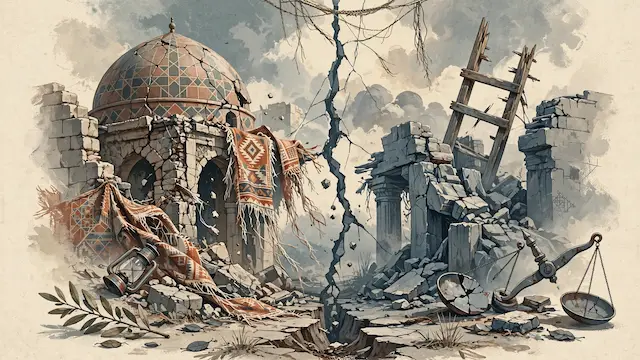
The article argues that bloodshed on the "land of Isra and Mi'raj" (referring to Jerusalem and its surroundings) inflicts not only physical wounds but also deep spiritual and civilizational damage. It posits that the shedding of human blood is a profound existential earthquake that shakes the foundations of society and undermines the meaning of coexistence. In this sacred land, where religious sites intersect with collective memory, every individual is seen as a guardian of identity and heritage. Therefore, pervasive violence, especially that which claims the lives of young people, is considered a grave sin against both heaven and earth.
The philosophical and ethical consequences of killing are described as a double destruction, impacting both the victim's and the perpetrator's families. The perpetrator's family faces psychological and social repercussions, potentially including displacement, fear of revenge, and collective punishment. Simultaneously, the victim's family endures the agony of loss. The article criticizes the failure of official justice systems and police to apprehend perpetrators, suggesting it fuels a cycle of vendettas that further erodes social cohesion.
The pervasive violence is depicted as a societal virus that shatters the sense of security, leading to the automatic dissolution of the social contract. When individuals feel unsafe in their homes, workplaces, and public spaces, the rule of law collapses, giving way to a "law of the jungle." The article emphasizes that the failure of authorities to seriously and firmly apprehend and hold murderers accountable is a betrayal of justice.
From a religious and ethical standpoint, the article invokes Islamic teachings, citing a hadith that warns of severe divine punishment for those who participate in the shedding of a believer's blood. It asserts the absolute value of human life, stating that the entire universe is less significant than the violation of a person's sanctity. The killer is seen as losing both worldly standing and divine favor, while preserving life is presented as the highest form of true religiosity and conscious humanity.
Ultimately, the piece calls for a comprehensive societal uprising against violence, urging families, dignitaries, intellectuals, and all concerned individuals to rise above tribalism and demand an end to killing. It advocates for a philosophy of survival, life, and unity, rather than destruction and fragmentation. The author stresses the need to form a united front against those seeking to dismantle the social fabric or incite conflict, promoting a culture of tolerance and the supremacy of law and ethics to make the land a beacon of internal peace and justice.