
US Midterms Could Empower Israel's Enemies, Analyst Warns
תורגם ותומצת מתוך Cursorinfo על ידי baba
Yagur believes that opposition to Israel is growing within the US, impacting public opinion and political discourse. He criticizes the Trump administration's incomplete military campaign against Iran and warns that a failure to decisively act could allow Iran to rebuild its strength and threaten Israel. Yagur calls for a complete campaign against Iran's regime and a strategic shift in how Israel engages with American society.
הידיעה ב-5 שורות · תקציר של baba
- Retired Lt. Col. Amit Yagur warns Israel's enemies may exploit US political divisions to gain regional advantage.
- He notes growing criticism of Israel in US public opinion and political discourse.
- Yagur criticizes the Trump administration's incomplete military campaign against Iran.
- He urges Israel and the US to complete a campaign against Iran's regime for stability.
- Yagur proposes a new strategy for Israel to engage with American society and public opinion.
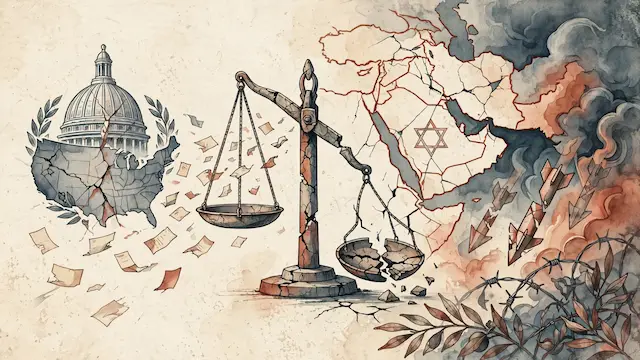
Opponents of Israel may exploit the US political crisis to bolster their regional standing, according to retired Lieutenant Colonel Amit Yagur, who spoke to Maariv. He believes the results of the US midterm elections could have significant security implications for Israel and strengthen its adversaries. Yagur suggests that Iran, Russia, China, Turkey, and Qatar are interested in weakening American influence and might leverage Washington's internal political divisions to thwart President East agenda.
Yagur views the current situation as a broad geopolitical confrontation where adversaries of the US and Israel are attempting to shift the global power balance through political and military means. He notes that Tehran perceives Republican electoral setbacks as a victory, linking them to the conflict in the Strait of Hormuz and growing American dissatisfaction with the White House's foreign policy.
This trend is exemplified by statements from Vice President J.D. Politicians advocating against military aid to Israel have gained prominence, including elected representative Adam Hamawi, who calls for a review of US support.
He outlines two opposing blocs: one comprising Russia, China, Iran, Pakistan, Turkey, and Qatar along with allied Islamist movements; the other including the US, Israel, India, the UAE, Jordan, Greece, and Cyprus. Yagur identifies the Muslim Brotherhood as playing a key role in influencing Western public opinion to weaken support for operations against Iran and its allies. He criticizes the Trump administration's incomplete military campaign against Iran, arguing that halting the operation allowed Tehran to recover and expand its influence.
Yagur warns that adversaries aim to prolong the conflict until Trump's term ends, seeking to exacerbate US internal divisions, halt military operations, and install a less Israel-friendly administration. This scenario, he fears, could allow Iran to rebuild its military capabilities and strengthen allies in Gaza and Lebanon, posing additional threats to Israeli security. Yagur urges Israel and the US to complete the campaign against Iran by overthrowing its regime for long-term stability. However, he stresses that military action alone is insufficient, advocating for a revised strategy to engage American society, focusing on public opinion and political movements. He proposes establishing a dedicated entity to strengthen Israel's position in the US, countering anti-Israel sentiments among various American groups. Delay, Yagur cautions, could lead to significant strategic consequences, allowing adversaries to alter the regional balance of power if Israel and the US fail to weaken Iran and maintain Western public support.
מוזכרים
לא אותו אירוע: ידיעות אחרות שחולקות עם הידיעה הזו אנשים, מקומות או נושא. רקע, תגובות והמשכים.




