
Israeli Stock Market Plunges Amid Election Uncertainty, Investors Debate Exit
The Tel Aviv Stock Exchange has experienced sharp declines and the shekel has weakened following Israeli election results that created political uncertainty. Investors, both foreign and domestic, are grappling with concerns about government formation and economic stability. Investment professionals advise focusing on long-term prospects rather than short-term volatility, with some suggesting that current market valuations may still be relatively high compared to historical averages.
הידיעה ב-5 שורות · תקציר של baba
- Israeli election results have triggered significant drops on the Tel Aviv Stock Exchange and weakened the shekel.
- Political uncertainty regarding government formation is causing foreign investors to exit the Israeli market.
- Eldad Tamir advised investors to focus on the long term and consider increasing dollar holdings.
- Uri Ben Dov stated that the stock market is still overvalued compared to its historical averages.
- Investment experts suggest that short-term market fluctuations should not dictate investment decisions.
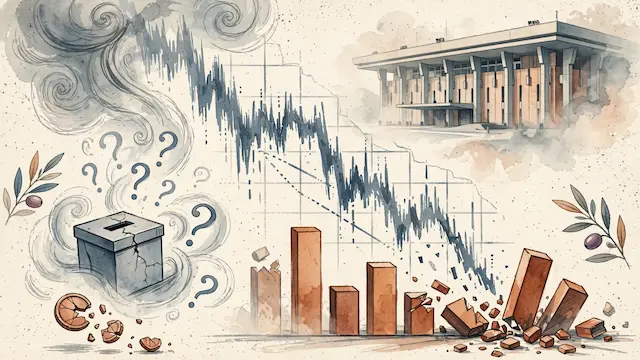
Following the recent election results, the euphoric optimism among Israeli investors has evaporated, replaced by uncertainty regarding government formation, budget approval, and the national deficit. This instability has sent the Tel Aviv Stock Exchange (TASE) into a sharp decline, with the Israeli shekel also weakening significantly.
Analysts suggest that foreign investors are exiting the market for purely economic reasons, unburdened by sentimental attachment. Israeli investors holding stocks are now facing a dilemma about whether to hold onto their portfolios or sell.
Eldad Tamir, co-owner of Tamir Fishman Investment House, described the situation as a "dead end," highlighting that investors dislike political instability, especially when no bloc appears capable of forming a government. He noted that even a coalition including Arab parties is perceived as unstable, as these parties could potentially bring down the government at will. Tamir believes that foreign investors are likely fleeing due to this uncertainty, as they lack emotional ties to the local market. He advised investors to consider the long term, suggesting that a solution will eventually emerge and recommending against immediate portfolio changes, perhaps only increasing dollar holdings.
Uri Ben Dov, CEO of IBI Mutual Funds, cautioned that while the stock market can behave erratically in the short term, it represents long-term wealth creation. He quoted the late Tsvi Lovetzky, a legendary investment house founder, who would tell panicked clients to "increase prayers," implying that short-term fluctuations are not the primary concern. Ben Dov pointed out that the TASE had experienced an artificial boom driven by election expectations, following an earlier surge related to Iran. He noted that even after recent drops, the TASE is still trading at higher multiples (15-17) compared to its historical average (12-13) and is less attractive than the US market, which trades at a multiple of 19. Ben Dov suggested that a further decline to a multiple of 12-13 would make the market more attractive, regardless of election outcomes or potential international sanctions.
מוזכרים
אותו אירוע, כפי שכל מערכת דיווחה עליו בנפרד. פתחו כמה דיווחים כדי להשוות מה כל מערכת מדגישה, ומה היא משאירה בחוץ.
מרכז 3



לא אותו אירוע: ידיעות אחרות שחולקות עם הידיעה הזו אנשים, מקומות או נושא. רקע, תגובות והמשכים.




