
Varying Voter Turnout Across Israel Reflects Deep Divides
תומצת מתוך Behadrei Haredim על ידי baba
Voter turnout data released at noon on election day in Israel showed significant disparities across different types of communities. Haredi cities like Modi'in Illit and El'ad reported high participation, while larger cities such as Tel Aviv and Jerusalem had lower rates. The Arab community displayed sharp differences, with Rahat showing high turnout compared to Umm al-Fahm. Settlements in Judea and Samaria also saw generally high engagement, with Avigail and Hashmonaim reporting nearly 50% and 39% respectively.
הידיעה ב-6 שורות · תקציר של baba
- Voter turnout varied significantly across Israel, with smaller towns and Haredi communities showing higher participation by noon.
- Rahat reported 36.9% turnout in the Arab community, contrasting with Umm al-Fahm's 18%.
- Haredi cities like Modi'in Illit and El'ad led with over 32% turnout.
- Opposition-aligned cities such as Ramat HaSharon reported 35% turnout, while Tel Aviv-Yafo was at 28.8%.
- Settlements in Judea and Samaria, including Avigail and Hashmonaim, showed high turnout rates.
- Larger cities like Jerusalem and Haifa had turnout rates around 27%, while Netanya was at 23.8%.
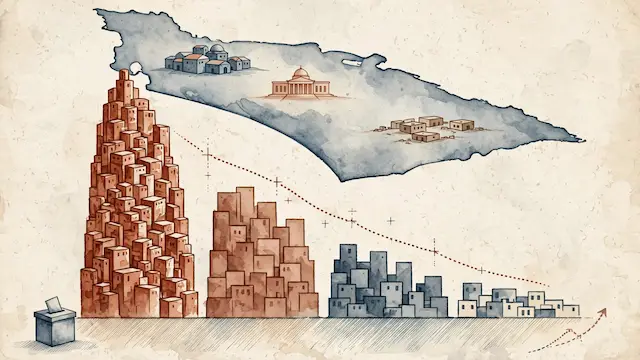
Six hours after polls opened, updated voter turnout data for noon revealed significant disparities across Israeli localities. While smaller communities reported exceptionally high participation rates, larger cities showed a different picture, with notable differences also emerging within the Haredi and Arab communities.
Among Haredi cities, Modi'in Illit led with 33.2% turnout, followed by El'ad at 32%. Bnei Brak recorded 28.4%, and Beitar Illit 28.3%. The Haredi town of Tifrah saw 38.5% participation, and Givat Ze'ev had 29.5%.
Sharp disparities were evident in the Arab community. Rahat stood out with a 36.9% turnout, approximately 12,000 votes. Kafr Qasim registered 26.9%, Nazareth and Tayibe 25% each, while Umm al-Fahm had a significantly lower rate of 18%, a gap of nearly 19 percentage points between Rahat and Umm al-Fahm.
Cities identified with the opposition also showed varied turnout. Ramat HaSharon reported 35%, Hod HaSharon 33.5%, Givatayim around 33%-34%, Kfar Saba 33%, and Ra'anana 32.5%. Herzliya had 29.3%, and Tel Aviv-Yafo recorded 28.8%.
Cities associated with the Likud party saw Ofakim leading among those surveyed with 30.8%, followed by Karmiel at 30%. Ashkelon and Migdal HaEmek registered 29% turnout, while Bat Yam was at 24%. These figures indicate differences even among cities with similar political leanings, though they do not yet reflect the distribution of votes among parties.
Settlements in Judea and Samaria generally showed high turnout. Karnei Shomron reported 35.5%, Elkana 35%, Alfei Menashe 34%, and Ariel 32%. Hashmonaim recorded 39%, and Avigail 49.5%.
Among the larger cities, Modi'in-Maccabim-Re'ut stood out with 36.7% turnout. Petah Tikva had 30.8%, Ashdod 30.4%, Rishon LeZion and Ramat Gan 29%, and Tel Aviv-Yafo 28.8%. Beersheba registered 27.4%, Haifa 27.3%, and Jerusalem 27.1%. Lod had 27%, while Netanya showed a relatively low rate of 23.8%.
The town of Attawana led among all surveyed localities with a 64% turnout, followed by Avigail at 49.5%, Giv'at Ya'arim at 40%, Yokneam and Hashmonaim at 39% each, and Tifrah at 38.5%. The report notes that in small communities, a limited number of voters can significantly impact the overall turnout percentage. Other localities reported 35% in Rosh HaAyin, 31.5% in Givat Shmuel, 26% in Safed, and 23.9% in Kiryat Shmona.
אותו אירוע, כפי שכל מערכת דיווחה עליו בנפרד. פתחו כמה דיווחים כדי להשוות מה כל מערכת מדגישה, ומה היא משאירה בחוץ.
ימין 3חרדית 1ערבית 1אחרים 1





לא אותו אירוע: ידיעות אחרות שחולקות עם הידיעה הזו אנשים, מקומות או נושא. רקע, תגובות והמשכים.



