
Israeli Election Focuses on Palestinian Conflict's Future
תומצת מתוך Haaretz על ידי baba
The Israeli election campaign, though focused on Benjamin Netanyahu, hinges on the future of the Palestinian conflict. Escalating violence and international pressure over settlements and policies in the West Bank and Gaza are key issues. Opposition leader Gadi Eisenkot calls for halting "Jewish terrorism" and freezing settlement expansion. Netanyahu appears committed to continued settlement growth despite potential sanctions, prioritizing it over economic stability and international relations.
הידיעה ב-5 שורות · תקציר של baba
- The Israeli election's core issue is the future of the Palestinian conflict, not just leadership.
- Western nations threaten sanctions over Israel's policies in the West Bank and Gaza.
- Opposition leader Gadi Eisenkot condemns "Jewish terrorism" and questions settlement expansion.
- Benjamin Netanyahu prioritizes settlement growth over international relations and economic stability.
- The conflict with Palestinians continues to shape Israel's political reality and decisions.
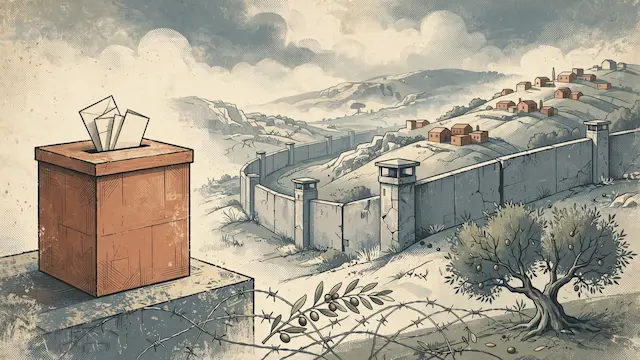
While the current Israeli election campaign has largely centered on Prime Minister Benjamin Netanyahu's leadership, the core issue at stake is the future of the conflict with the Palestinians. Past elections saw security and foreign relations sidelined under the illusion that the conflict was managed, but the October 7th Hamas attack and the subsequent war served as a stark reminder of the consequences of ignoring the Palestinian issue. The situation is now significantly more complex, with two million displaced Palestinians in Gaza, Israeli control over most of the Strip, and a concerted effort in the West Bank to confine Palestinians to shrinking enclaves through planned construction, land seizures, and settler violence. Western nations are threatening sanctions over Israel's policies, and calls to limit or halt military aid are growing in the United States.
The incoming government will face the critical question of whether to continue expanding settlements in the West Bank and hindering Gaza's reconstruction, or to seek de-escalation to mitigate international criticism and accusations of genocide. Netanyahu appears to have chosen a path of persistent settlement expansion and Jewish terrorism in the West Bank, even at the risk of crippling sanctions, which he once advocated for Iran. His declaration that Israel would use cryptocurrency if disconnected from the international financial system, and his prioritization of construction in the E1 area near Ma'ale Adumim over a prosperous economy, suggest this stance. While these statements could be dismissed as campaign rhetoric, his government has actively deepened the occupation and repression of Palestinians, supported by a significant portion of the Israeli public since October 7th.
Few Israelis express empathy for Palestinians, particularly those in Gaza. The escalating harm to Palestinians in the West Bank, while Gaza recedes from headlines, has reignited political debate over control of the territories and criticism of Netanyahu's actions, often framed as a risk to relations with the West. Gadi Eisenkot, a leader of the opposition's Change Bloc, explicitly speaks of "Jewish terrorism" and questions the timing of the E1 construction plan, a position previously held by all Israeli governments. Eisenkot, with his military background, understands that the international community expects a change in direction in the West Bank if he replaces Netanyahu. This would involve freezing tenders and decisively halting Jewish terrorism, not necessarily establishing a Palestinian state or reviving the Oslo process.
This will be challenging, as settlers and their political patrons will fiercely resist any changes, and the Change Bloc itself faces internal ideological divisions. Netanyahu has attempted to frighten voters with the idea of "Palestine" to distract from his pre-war and wartime failures and Qatar's influence. He also knows his opponents are hesitant to address the Palestinian issue for fear of appearing weak. However, beneath the slogans and political positioning, the reality remains: the conflict with the Palestinians shapes Israel and continues to be central to its political existence and decision-making, regardless of how often it is discussed or how solutions are proposed.
לא אותו אירוע: ידיעות אחרות שחולקות עם הידיעה הזו אנשים, מקומות או נושא. רקע, תגובות והמשכים.


