
Greece Prepares for Subsea Power Cable Project Amid Turkish Tensions
Greece is moving forward with its Interconnector subsea power cable project linking it to Cyprus and Israel, prompting conflicting maritime warnings from Turkey. A French survey ship is set to begin work south of Crete, an area claimed by both Greece and Turkey, raising fears of military confrontation. Turkey opposes the project due to its conflict with its "Blue Homeland" doctrine and a disputed maritime border agreement. Greece, bolstered by recent defense acquisitions, appears more resolute this time, potentially involving the US and France.
הידיעה ב-5 שורות · תקציר של baba
- Greece is proceeding with a subsea power cable project connecting it to Cyprus and Israel, sparking maritime disputes with Turkey.
- A French survey ship's upcoming work south of Crete has led to conflicting NAVTEX warnings from Greece and Turkey.
- Turkey opposes the project, viewing it as a violation of its "Blue Homeland" maritime doctrine and a disputed border agreement.
- Greece's resolve has strengthened following significant defense purchases from Israel.
- Turkey is significantly increasing its defense procurement budget, signaling a continued assertive stance.
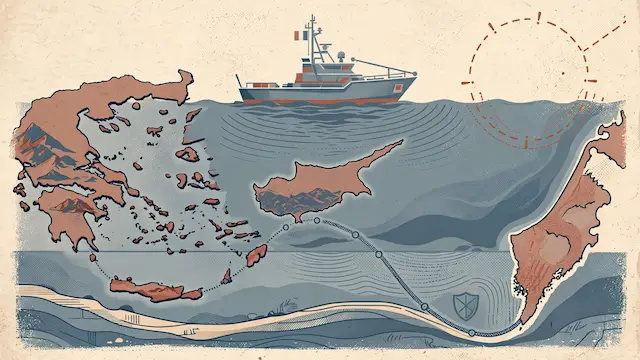
Greece is preparing to resume work on the Interconnector project, a high-voltage subsea power cable intended to link its electricity grid with Cyprus and Israel. The French survey ship "Abeille Maringo" is expected to conduct maritime surveys in the area soon. This move, however, risks escalating tensions with Turkey, as Athens and Ankara have conflicting views on maritime borders, including those of Cyprus. The potential clash point is south of Crete.
Concerns over a military confrontation were evident last weekend when Greece announced a closed sea area south of Crete for a military exercise involving Cyprus, France, and Italy. Turkey responded with a counter-NAVTEX for the same area, which it considers under its jurisdiction. A NAVTEX is a maritime broadcast warning sailors of potential dangers from military exercises.
This is not the first time Turkey has reacted forcefully to the project. About 18 months ago, Greece postponed cable-laying operations between Rhodes and Crete after Turkey threatened to cut the cables, opting to avoid a military confrontation. However, Greece's recent multi-billion dollar defense procurement from Israel has apparently bolstered its resolve.
Ankara strongly opposes the Interconnector project because it is slated to pass through an area defined by the 2019 Turkish-Libyan maritime border agreement. This agreement, a key element of Erdogan's "Blue Homeland" doctrine, creates a maritime border at the expense of Greek territory and reflects Turkey's neo-Ottoman maritime ambitions in the Eastern Mediterranean and beyond.
Turkey's determination to prevent the cable's deployment without its consent is evident in its military buildup. Vice President Cevdet Yilmaz announced a 229% increase in Turkey's defense procurement budget for 2027. Experts note that Turkey views the Interconnector as strategically vital for Israel, providing critical backup and redundancy for its infrastructure. Greece, backed by the European Union and potentially the US and France, appears less inclined to back down this time.
מוזכרים
אותו אירוע, כפי שכל מערכת דיווחה עליו בנפרד. פתחו כמה דיווחים כדי להשוות מה כל מערכת מדגישה, ומה היא משאירה בחוץ.
מרכז 1אחרים 1


לא אותו אירוע: ידיעות אחרות שחולקות עם הידיעה הזו אנשים, מקומות או נושא. רקע, תגובות והמשכים.
