
Israeli hospital uses sound waves to break opioid addiction in 20 minutes
Rambam Medical Center used Israeli ultrasound technology to help a man in his 40s overcome severe opioid dependence in a 20-minute procedure. Doctors said the treatment sharply reduced his cravings and may open the door to new noninvasive therapies for addiction and other brain disorders.
הידיעה ב-5 שורות · תקציר של baba
- Rambam treated a man in his 40s who had taken about 130 pain pills daily.
- The noninvasive procedure used Insightec’s focused ultrasound technology.
- Doctors said his opioid craving fell to zero and tests were later negative.
- The trial is part of a multinational study also running at three U.S. centers.
- Researchers say the method could eventually help treat addiction, PTSD, OCD and more.
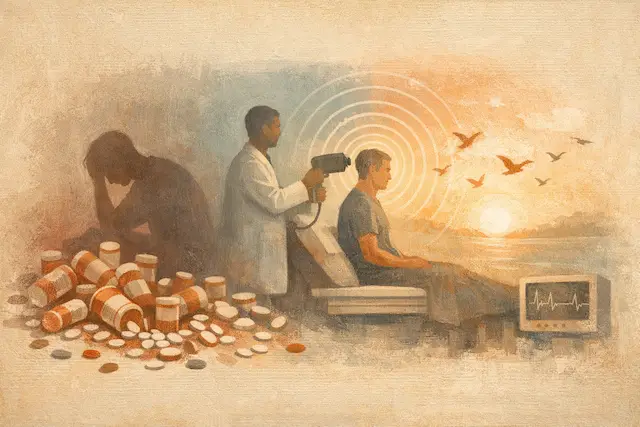
Rambam Medical Center in Haifa recently carried out Israel’s first treatment of its kind, helping a man in his 40s stop his dependence on painkillers in just 20 minutes. The patient, identified only as H. and described as a northern resident, had been taking about 130 pain pills a day after a neck injury years earlier. The procedure used a unique Israeli technology from Insightec and is part of an international study now running at a small number of medical centers in the United States, as well as in Israel.
Dr. Lior Lev-Tov, who heads functional neurosurgery at Rambam and leads the research, called it “a new therapeutic platform” offering a range of noninvasive treatments. He said it is “a first-rate scientific breakthrough” that could change how doctors treat people. During the treatment, the team targeted electrical activity in the nucleus accumbens, a brain region central to reward, pleasure and motivation. Unlike older approaches that use focused ultrasound under MRI guidance to heat and destroy tissue, this version is designed for neuromodulation without heating or damaging brain tissue.
Dr. Amir Minarbi, head of Rambam’s pain medicine institute, said H. no longer had pain but remained dependent on the drugs for calm and daily functioning. After the procedure, the doctors saw an immediate drop in his craving. H. reported zero out of ten craving for the drug, and an unexpected sharp reduction in cigarette use, from three packs a day to only a few cigarettes, with no desire for alcohol. A week later, tests were negative for opioids and other substances, and the patient said he had “got his life back.”
The trial is being conducted at three U.S. centers and has so far shown excellent results in preserving opioid withdrawal gains. Rambam said some participants were addicted to heroin, and H. was the first to undergo treatment while in active withdrawal, which the doctors said added value to the study. Minarbi said opioid addiction is a global epidemic that has killed hundreds of thousands in the United States and costs about $60 billion a year there, while Lev-Tov said the technology could eventually help with PTSD, OCD, eating disorders, other addictions, severe depression, chronic pain, attention disorders, Alzheimer’s and Parkinson’s.
אותו אירוע, כפי שכל מערכת דיווחה עליו בנפרד. פתחו כמה דיווחים כדי להשוות מה כל מערכת מדגישה, ומה היא משאירה בחוץ.
מרכז 5ימין 2






