
Iran Lists Terms for Strait of Hormuz Reopening to US
תורגם ותומצת מתוך Arab48 על ידי baba
Iran has presented the US with conditions for reopening the Strait of Hormuz, including lifting sanctions and releasing frozen assets. The IRGC has stated that Iran has hardened its demands and warned of severe retaliation for any further US attacks.
הידיעה ב-5 שורות · תקציר של baba
- Iran demands US lift blockade, release assets, and end war on resistance fronts.
- Iran has hardened its demands following a collapsed prior agreement.
- The IRGC warned of a broader, offensive response to any new US attacks.
- Iran added the lifting of the blockade on Yemen to its demands.
- The IRGC rejected direct communication attempts from the US.
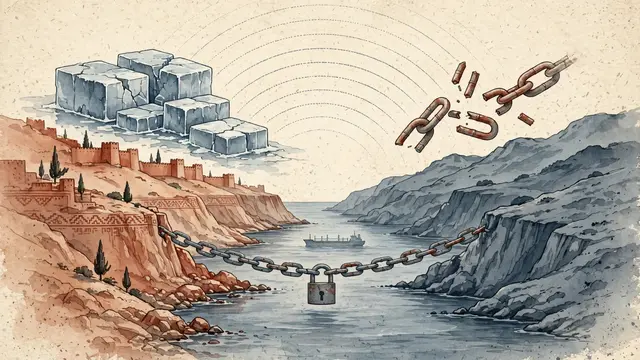
Iranian Foreign Minister Mohammad Javad Zarif, through his envoy Abbas Araghchi, presented Tehran's conditions to US envoy Steve Lutfi for reopening the Strait of Hormuz during a meeting in New York. The demands include lifting the US naval blockade, releasing frozen Iranian assets, and ending the war on "resistance fronts." The Islamic Revolutionary Guard Corps (IRGC) announced that Iran has hardened its demands and warned of a broader response if US attacks resume.
According to Iranian state media on Tuesday, Araghchi met with Lutfi on the sidelines of the UN General Assembly meetings. Araghchi conveyed Tehran's "firm" demands for reopening the strategic strait, which has been closed for months amid the US-Israel "war on Iran." Iranian state television quoted Araghchi stating the demands encompass the "immediate lifting of the US naval blockade, the urgent release of all frozen Iranian assets, and the end of the war on all resistance fronts."
An informed source told Iranian television that the meeting between Araghchi and Lutfi was held at the "insistence" of the US side, and Tehran agreed to convey its conditions for reopening the Strait of Hormuz. This meeting marks the first public presentation of Iran's terms for reopening the strait amidst ongoing diplomatic efforts in New York by intermediary parties seeking to re-establish political dialogue between Washington and Tehran.
US President Donald Trump had previously stated that his envoys, Steve Lutfi and Jared Kushner, held a "very productive" three-hour meeting with an Iranian delegation, expressing anticipation for an agreement. Lutfi also described the meeting positively. Earlier reports indicated the possibility of further meetings.
Concurrently, IRGC spokesperson Hossein Salami announced that Tehran has raised its demands following the collapse of a memorandum of understanding with the US in June. Salami stated that the US violated the agreement, leading Iran to "tighten its conditions." He warned that continued US actions would only complicate matters for Washington, asserting that Iran "won the war" and is not to be trifled with.
The previous understanding in June reportedly included lifting US sanctions on oil, ending the naval blockade on Iranian ports, and releasing frozen assets. However, the understanding later collapsed, with both sides accusing the other of violations. Salami revealed that a key change in Iran's conditions is the demand for the immediate release of the full $24 billion in frozen Iranian assets before negotiations begin, rather than a gradual release.
Furthermore, Iran has added the issue of Yemen to its new demands, calling for the lifting of the blockade on Yemen as part of any agreement. This comes amid Houthi advances in western Yemen and their control of areas overlooking the Red Sea and the Bab el-Mandeb strait, increasing the importance of maritime routes in the regional confrontation. The Strait of Hormuz and the Bab el-Mandeb strait are central to the economic and security implications of the ongoing conflict, particularly for international energy and trade.
Salami asserted that the US economic blockade will not achieve its objectives, despite acknowledging the damage it inflicts on Iran. He warned that any new US attacks would be met with a stronger response, stating Iran would adopt an "offensive stance" and that America would "regret its actions and suffer greater humiliation than ever before." He did not rule out the possibility of the Iranian response including other countries if they participate in new attacks on Iran, emphasizing that Iran does not seek to expand the war.
Regarding direct communication, Salami stated that while the Iranian Foreign Ministry handles diplomatic channels, the IRGC has rejected direct contact attempts from the US, asserting that any engagement with the US, as long as it maintains its hostility, will be exclusively through military means.
מוזכרים
אותו אירוע, כפי שכל מערכת דיווחה עליו בנפרד. פתחו כמה דיווחים כדי להשוות מה כל מערכת מדגישה, ומה היא משאירה בחוץ.
מרכז 2חרדית 2ערבית 1אחרים 1





לא אותו אירוע: ידיעות אחרות שחולקות עם הידיעה הזו אנשים, מקומות או נושא. רקע, תגובות והמשכים.
