Sign in to baba News

The Desk, the news read to you every hour, is part of News Plus.

or use an email code

Keep the whole picture

News Plus opens the cross-newsroom layer — who covered a story, who didn’t, and how each one worded it.

  • Unlimited follows
  • Alerts for what you follow (in the app)
  • Story alerts (in the app)
  • Hide read stories
  • The daily brief by email
  • Headlines side by side
  • Who reported first
  • The whole archive
  • Your reading diet
  • Duki without the daily limit
  • The Desk: the news, spoken every hour
  • Catch Me Up, and what changed since you read it
  • The Live Terminal

Eligible new subscribers get 7 days free, then $34.99 each year. Renews automatically until cancelled. Cancel any time in your account. Subscription terms.

Your subscription also unlocks the app.

Sign in to baba News

One account across the web, iPhone and Android — your subscription follows it.

or use an email code

Welcome — one more step

News Plus opens the cross-newsroom layer — who covered a story, who didn’t, and how each one worded it.

  • Unlimited follows
  • Alerts for what you follow (in the app)
  • Story alerts (in the app)
  • Hide read stories
  • The daily brief by email
  • Headlines side by side
  • Who reported first
  • The whole archive
  • Your reading diet
  • Duki without the daily limit
  • The Desk: the news, spoken every hour
  • Catch Me Up, and what changed since you read it
  • The Live Terminal

Eligible new subscribers get 7 days free, then $34.99 each year. Renews automatically until cancelled. Cancel any time in your account. Subscription terms.

Your subscription also unlocks the app.

Search stories

Type at least two characters. Results come from every newsroom baba reads.

↑↓ to move · ↵ to open · esc to close

Sign in to baba News

Sign in to keep asking. News Plus removes the daily limit.

or use an email code

Keep the whole picture

News Plus opens the cross-newsroom layer — who covered a story, who didn’t, and how each one worded it.

  • Unlimited follows
  • Alerts for what you follow (in the app)
  • Story alerts (in the app)
  • Hide read stories
  • The daily brief by email
  • Headlines side by side
  • Who reported first
  • The whole archive
  • Your reading diet
  • Duki without the daily limit
  • The Desk: the news, spoken every hour
  • Catch Me Up, and what changed since you read it
  • The Live Terminal

Eligible new subscribers get 7 days free, then $34.99 each year. Renews automatically until cancelled. Cancel any time in your account. Subscription terms.

Your subscription also unlocks the app.

Study Finds Israel's 'Basket of Goods' Program Lowers Some Prices but Raises Others, Undermining Savings
By ערוץ 7
Translated & summarized from Arutz Sheva by baba
Study Finds Israel's 'Basket of Goods' Program Lowers Some Prices but Raises Others, Undermining Savings
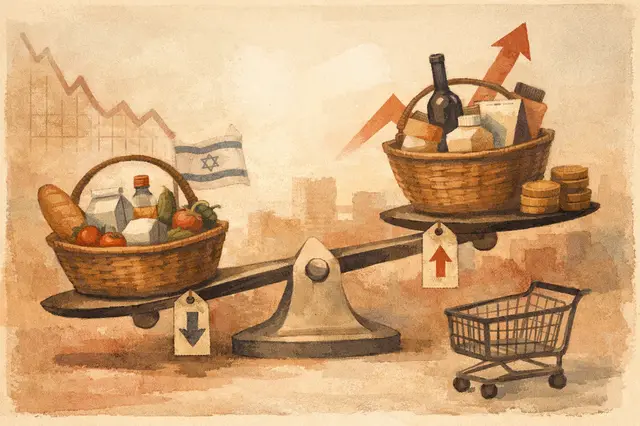
Editorial illustration generated by baba News — not a photograph of the event.
The story · English

A pioneering study by the Coller School of Management at Tel Aviv University evaluated the impact of Israel's "Basket of Goods" program about two months after its implementation. The research revealed that while the program significantly reduced prices of designated basket products, it simultaneously caused price increases in other items, potentially negating consumer savings.

The study, conducted by Prof. Itay Atar, Adi Omer from Tel Aviv University, and Dr. Or Avishi-Rizi from Pompeu Fabra University in Barcelona, analyzed daily price data from Pricez, covering approximately 70 supermarket sub-chains and over 2,000 branches across Israel during the program's first seven weeks. Results showed a 35% price drop for basket products at participating Carrefour stores and a 37% decrease on Carrefour's online platform. However, outside Carrefour, price reductions were limited, with no significant drops across all food chains and only about a 3% average decrease in major discount chains.

Concurrently, the study identified price hikes in non-basket products. At Carrefour physical stores, 46 of 76 product categories saw price increases, 23 of which were statistically significant; online, 55 categories increased, with 31 statistically significant. Additionally, 86 popular non-basket products rose in price by about 1.5% in stores and 2% online. The research also found that major supermarket chains set prices nationally rather than competing locally around participating branches.

Prof. Atar commented, "The program succeeded in lowering basket product prices at Carrefour and somewhat influenced competitors, but in economics, there are no free gifts." He emphasized that while consumers saved on basket items, they paid more for others, suggesting the overall shopping bill might not have decreased. "The true test is the total checkout amount, and in this respect, the effort to reduce the shopping cart cost may have backfired."

Read the original at Arutz Sheva
Full coverage · 9 outlets
57% centerFirst: Calcalist · Jun 28

The same event, reported separately by each outlet. Open a few to compare what different newsrooms emphasize — and what they leave out.


Center 4Right 3Unrated 2
Related stories · 5

Not the same event — other stories that share this one’s people, places, or theme: background, reactions, and follow-ups.


Ask About This Article

Duki reads it, and every newsroom on the same story, then answers with sources.

Open the live terminal