Israel's Competition Authority Approves Major Gas Deal Valued at $6.7 Billion
Translated & summarized from Israel Hayom by baba
Israel's Competition Authority approved a $6.7 billion gas deal between NewMed Energy, Ratio Energies, and Dalia Energy, allowing separate sales from the Leviathan field. The decision signals a potential shift in regulatory approach to foster competition within the dominant gas field.
The story in 5 lines · by baba
- Competition Authority approved a $6.7 billion gas deal involving the Leviathan field.
- The deal allows separate gas sales by NewMed Energy and Ratio Energies to Dalia Energy.
- The authority sees separate sales as a way to foster competition within the Leviathan field.
- The decision acknowledges the concentrated nature of Israel's gas market.
- Restrictions on secondary gas trading were not approved by the authority.
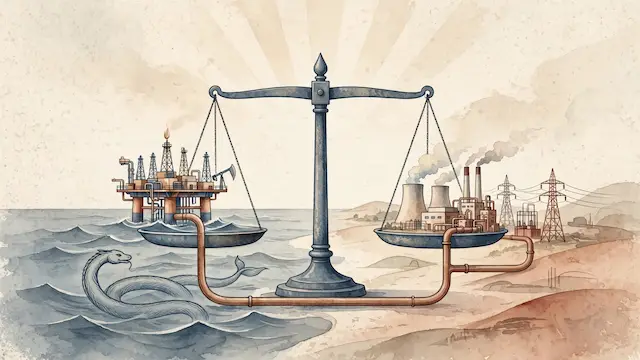
Israel's Competition Authority has greenlit a significant natural gas deal, potentially one of the largest in the local market in recent years. The Commissioner of Competition, Michal Cohen, decided to grant an exemption from restrictive arrangement approval for an agreement between NewMed Energy, part of the Delek Group controlled by business magnate Yitzhak Tshuva, and Ratio Energies. Together, these entities hold approximately 60.3% of the Leviathan gas field.
The deal, valued by the parties at around $6.7 billion, involves the purchase of gas for two new power stations Dalia Energy plans to build in Ashdod and Tzafit. These new units are expected to have a capacity of about 850 megawatts each. Gas supply is slated to begin in January 2030 and continue for up to 20 years. Initially, NewMed and Ratio will supply about 1.3 billion cubic meters (BCM) of gas annually, increasing to approximately 1.7 BCM per year from mid-2034 to mid-2035. Dalia Energy has committed to a 'take or pay' mechanism, ensuring a minimum purchase or payment for gas, with the price linked to the general electricity tariff.
The Competition Authority's decision is notable given its assessment of the gas market's structure. The authority acknowledges the market is concentrated with few players and warns that Leviathan could become Israel's sole significant gas field in the long term without new discoveries. Despite this, the authority emphasized the importance of deals where gas is not sold jointly by all field partners. The decision suggests that separate sales by some Leviathan partners, particularly without the field's operator, can introduce a degree of competition in gas supply to consumers.
This marks a shift in the authority's approach, moving from viewing joint marketing by field rights holders as essential to recognizing that separate sales among partners can foster competition within the same field. The authority also accepted the argument that long-term contracts and the 'take or pay' mechanism are necessary for financing these capital-intensive power projects, providing supply and price certainty for financiers and demand stability for suppliers.
However, the authority drew a line on secondary trading, deeming the agreement's restriction on Dalia Energy reselling purchased gas unjustified due to current transmission capacity. This specific restriction is not covered by the exemption, and the parties must independently assess its compliance with competition laws. Ultimately, the Commissioner concluded that despite the risks of long-term gas contracts, this specific deal is unlikely to significantly harm competition, signaling a potential new strategy for maintaining competition in Israel's gas market.
Mentioned