
Israel Approves $6.7 Billion Leviathan Gas Deal
Translated & summarized from Walla by baba
Israel's Commissioner of Competition approved a $6.7 billion gas deal between Dalia Energy and Leviathan field partners NewMed Energy and Ratio Energies. The agreement will supply gas to new power plants, with supply starting in 2030 and lasting 20 years. The deal was approved despite market concentration concerns, as potential negative impacts were deemed mitigated.
The story in 5 lines · by baba
- Israel approved a $6.7 billion gas deal for the Leviathan field.
- The deal is between Dalia Energy, NewMed Energy, and Ratio Energies.
- Gas supply to new power plants begins January 1, 2030.
- The agreement spans 20 years and includes price adjustment mechanisms.
- The Commissioner found the deal would not significantly harm competition.
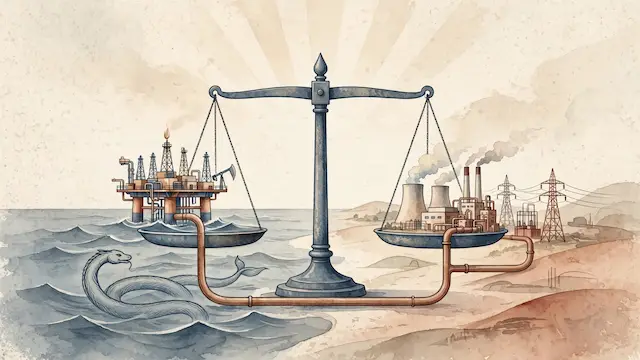
Israel's Commissioner of Competition, Michal Cohen, has approved a significant natural gas deal worth approximately $6.7 billion involving the Leviathan gas field. The agreement is between Dalia Energy Companies Ltd. and two partners in the Leviathan field, NewMed Energy and Ratio Energies. The approval was granted after consultation with the Committee for Exemptions and Mergers, which determined that the deal would not significantly harm competition in the relevant markets.
The agreement, signed on May 19, 2026, will supply natural gas from the Leviathan field to two new combined-cycle power generation facilities, each with a capacity of about 850 megawatts. These facilities are being built by subsidiaries of Dalia at the Ashbol power station in Ashdod and the Tzafit power station. Gas supply is scheduled to commence on January 1, 2030, and will continue for 20 years from the commercial operation date of the new units.
Under the terms, NewMed (holding 45.34% of Leviathan) and Ratio (holding 15%) commit to supplying a cumulative annual volume of approximately 1.3 billion cubic meters (BCM) of firm gas. This volume will increase to about 1.7 BCM annually between early 2034 and mid-2035 until the agreement's end. Dalia is obligated to purchase or pay for a minimum annual quantity, calculated on a "Take or Pay" basis.
The gas price is linked to the general electricity tariff, similar to existing commitments for Leviathan stakeholders related to its export approval. The deal includes mechanisms for price and quantity adjustments. Starting October 1, 2041, either party can request a price review, with adjustments capped at 10%. If no agreement is reached, the requesting party can reduce daily contractual quantities by up to 30%. Dalia also has an option to adjust the pricing mechanism for gas supplied to existing steam units at the Ashbol site.
In its competitive analysis, the Commissioner noted that Israel's natural gas supply market is concentrated with few players. Leviathan holds the largest reserves (approximately 572 BCM), compared to Tamar (271 BCM) and the Karish-Tannin fields (126 BCM). In 2025, Leviathan supplied about 12% of Israel's total gas consumption, while Tamar supplied 47% and Karish 8.41%. The power generation sector accounts for roughly 79% of domestic gas consumption.
While acknowledging that long-term agreements and "Take or Pay" clauses can create stability but potentially block new entrants, the Commissioner found that future quantity reduction mechanisms and expected demand growth mitigate these concerns in this case. Regarding a clause limiting Dalia's resale of gas to third parties, NewMed referred to a previous notice of agreement cancellation but did not withdraw its exemption request. Due to the urgency, the Commissioner left the legality of this specific clause for the parties to examine themselves.
Mentioned




