Nobel Prize in Medicine Awarded for Optogenetics, With Israeli Contributions Recognized
Translated & summarized from Vesty by baba
The story in 5 lines · by baba
- Nobel Prize in Medicine awarded for optogenetics research.
- Laureates are Karl Deisseroth (USA), Peter Hegemann, and Georg Nagel (Germany).
- Optogenetics allows precise control and observation of brain activity.
- Israeli institutions have made key contributions to the field.
- The prize includes a monetary award of 12 million Swedish kronor.
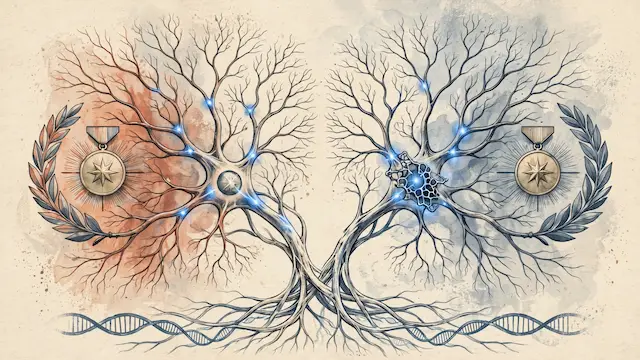
The 2026 Nobel Prize in Physiology or Medicine has been awarded to Professor Karl Deisseroth from the U.S., a psychiatrist and researcher at Stanford University, and two German scientists: Professor Peter Hegemann of Humboldt University of Berlin and Professor Georg Nagel of the University of Würzburg. The Nobel Committee recognized their groundbreaking work on light-controlled ion channels and the development of optogenetics. The award, shared among the three laureates, amounts to 12 million Swedish kronor, approximately 3.7 million shekels.
Optogenetics has revolutionized neuroscience by enabling scientists to map the brain with unprecedented precision. According to the committee, the method allows observation of how nerve cells form memories, emotions, and behavior in a living brain, fundamentally altering our understanding of its workings. This technique allows for the precise activation or inhibition of specific neuron groups in real-time, facilitating the mapping of neural networks responsible for fear, memory, addiction, and depression.
The discovery originated from research in the early 2000s when Hegemann and Nagel identified a gene in a single-celled green alga similar to a light-sensitive protein gene. They named the resulting protein channelrhodopsin. Deisseroth then successfully tested this protein in neurons, demonstrating that blue light could trigger an electrical impulse. Later, his lab introduced a protein activated by yellow light to inhibit neuronal activity. A landmark experiment involved a mouse, whose brain was implanted with an optical fiber, causing it to circle repeatedly when a laser was activated.
While Israeli scientists have not yet received the Nobel Prize in Medicine, Israel has significantly contributed to the field. In 2016, the Technion honored Deisseroth and Hegemann with the Harvey Prize for their optogenetics research. Professor Ofer Izhar from the Weizmann Institute of Science in Rehovot conducted postdoctoral research in Deisseroth's lab, developing new optogenetic methods, some in collaboration with Hegemann's team. Since 2011, Izhar has led his own optogenetics lab at the Weizmann Institute.
Israel has previously received Nobel Prizes in Chemistry directly related to medicine. In 2004, Professors Avram Hershko and Aaron Ciechanover of the Technion, along with Irwin Rose, were awarded the prize for discovering the mechanism of protein ubiquitination. In 2009, Professor Ada Yonath of the Weizmann Institute received the Chemistry prize for her work on the structure of the ribosome, which has been crucial for developing new antibiotics. Yonath, the only woman in Israel to have won a Nobel Prize, passed away in late August at age 87.
The Nobel Prize in Medicine has been awarded annually by the Karolinska Institute since 1901 for significant discoveries in physiology and medicine. This year marks the 125th anniversary of the prize. The selection process for the laureates begins over a year in advance, with nominations solicited from thousands of experts worldwide, followed by rigorous review by the Nobel Committee. The full list of nominees is kept secret for 50 years.
Mentioned