
Nobel Prize in Physiology or Medicine Awarded for Optogenetics Breakthrough
Translated & summarized from Calcalist by baba
The story in 6 lines · by baba
- Nobel Prize awarded for optogenetics research on light-controlled ion channels.
- Deisseroth, Hegemann, and Nagel are the 2026 Physiology or Medicine laureates.
- Optogenetics enables precise control of nerve cells using light.
- The technique has advanced brain research and potential treatments.
- Israeli scientists have contributed to the development of optogenetics.
- The prize includes 12 million Swedish kronor.
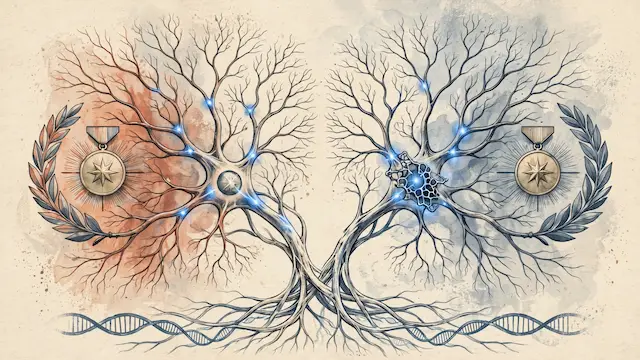
The 2026 Nobel Prize in Physiology or Medicine has been awarded to three researchers for their foundational work in optogenetics: American Professor Karl Deisseroth, a psychiatrist and researcher at Stanford University, and Germans Professor Peter Hegemann of Humboldt University of Berlin and Professor Georg Nagel of the University of Würzburg. The Nobel Committee recognized them "for their discoveries concerning light-controlled ion channels and optogenetics." The laureates will share the prize money of 12 million Swedish kronor, approximately $3.7 million.
The research originated from the study of green algae, which sense light and move towards it. In the early 2000s, Hegemann and Nagel discovered the protein enabling this behavior: a tiny channel in the cell membrane that opens upon exposure to light, allowing electrically charged particles into the cell. Deisseroth realized that by introducing this protein into nerve cells, they could be activated by flashes of light. In 2005, he and his colleagues successfully achieved this, thus establishing the new field of optogenetics, a term combining optics and genetics, as researchers insert the gene for the light-sensitive protein into cells.
Optogenetics has revolutionized neuroscience. It allows researchers to activate or silence specific nerve cells in the brains of living mice within milliseconds, enabling the study of how this affects their behavior. This has led to the identification of neural circuits associated with fear, memory, addiction, and depression. In 2021, researchers reported the first instance of restoring partial vision in a blind individual with a genetic retinal disease using optogenetics. By introducing a light-sensitive protein into the eye and using special glasses, the patient could detect and count objects.
Israel also has a connection to this field. In 2016, the Technion awarded Deisseroth and Hegemann the Harvey Prize for their development of optogenetics. Professor Ofer Yizhar from the Weizmann Institute of Science conducted his postdoctoral research in Deisseroth's Stanford lab, contributing to the field's toolkit as a young researcher. Since 2011, he has led his own optogenetics lab at the Weizmann Institute.
The Nobel Prize in Physiology or Medicine has been awarded annually since 1901, based on the will of Alfred Nobel, who stipulated it should go to the person who made the most important discovery in the field. The selection process involves thousands of nominations, rigorous examination by the Nobel Committee and experts, and a final decision by a majority vote of 50 professors at the Karolinska Institute. Nominees' names are kept secret for 50 years, with lists of past nominees often revealing surprising omissions, such as Sigmund Freud, who was nominated 32 times but never won.
Last year's prize was awarded to Professors Mary Brunkow and Dr. Fred Ramsdell from the U.S., and Professor Shimon Sakaguchi from Japan, for their research on regulatory T cells, which play a crucial role in the immune system, opening new avenues for treating autoimmune diseases, cancer, and transplants. Dr. Ramsdell famously discovered his win while on a camping trip, far from cell service.
Previous Nobel laureates in related fields include American biologists Professors Victor Ambros and Gary Ruvkun, who discovered microRNA and were awarded the Israeli Wolf Prize for it in 2016, the same year Israeli-Canadian Professor Nachum Sonenberg also received the Wolf Prize. In 2023, Professors Katalin Karikó and Drew Weissman received the Nobel Prize for their work that paved the way for mRNA vaccines against COVID-19.
Notable facts about the Nobel Prize include the youngest recipient, Frederick Banting (age 32 in 1923), and the oldest, Peyton Rous (age 87 in 1966). No one has won the Nobel Prize in Medicine twice. Gerty Cori was the first of 14 women to win, sharing the prize with her husband Carl in 1947; another couple, May-Britt and Edvard Moser, won in 2014. In 1939, German researcher Gerhard Domagk was forbidden by Hitler from accepting the prize, receiving his medal and diploma years later without the monetary award. In 2011, Ralph Steinman was posthumously awarded the prize, as the committee was unaware of his death at the time of selection.
Israel has not yet had a Nobel laureate in Medicine, but has received two Nobel Prizes in Chemistry for research closely related to medicine. In 2004, Professors Avram Hershko and Aaron Ciechanover from the Technion, along with American Professor Irwin Rose, won for discovering the mechanism for marking proteins for degradation. In 2009, Professor Ada Yonath of the Weizmann Institute of Science won for deciphering the structure of the ribosome, sharing the prize with Thomas Steitz and Venkatraman Ramakrishnan. Professor Yonath, the only Israeli woman to win a Nobel Prize, passed away in late August at age 87.
Announcements for the remaining 2026 Nobel Prizes will continue this week: Physics on Tuesday, Chemistry on Wednesday, and Literature on Thursday. The Peace Prize will be announced in Oslo on Friday, followed by the Sveriges Riksbank Prize in Economic Sciences in Memory of Alfred Nobel in Stockholm on Monday, October 12. The award ceremony will take place on December 10, the anniversary of Nobel's death.
Mentioned
The same event, reported separately by each outlet. Open a few to compare what different newsrooms emphasize — and what they leave out.
Centre 1Other 2


Not the same event — other stories that share this one’s people, places, or theme: background, reactions, and follow-ups.
