
Settler Violence Escalates in West Bank Villages, Religious Symbols Used to Justify Attacks
Translated & summarized from Local Call by baba
The story in 5 lines · by baba
- Settler attacks in Palestinian villages used religious symbols to justify violence.
- An inscription "We do not dismantle a sukkah" appeared on a damaged Palestinian home.
- The violence is part of a strategy to make Palestinian life impossible in the region.
- Religious symbols are being co-opted to provide moral justification for attacks.
- The attacks occurred in villages east of Ramallah and south of Nablus.
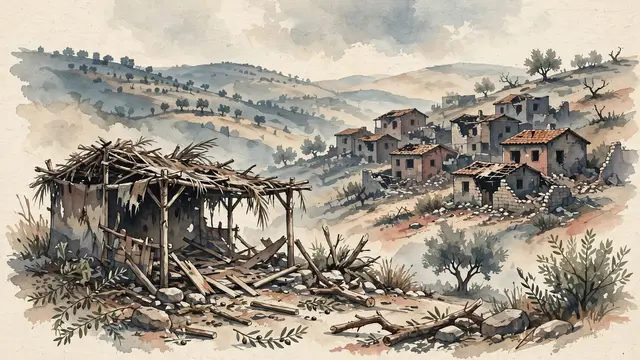
Recent coordinated attacks by Israeli settlers on Palestinian villages east of Ramallah and south of Nablus, including arson and property damage, are part of a broader strategy to make Palestinian life untenable in the region. The violence, which occurred overnight and into the morning, targeted villages such as Abu Falah, Jalud, and Al-Mughayir. In Al-Mughayir, six cars were set ablaze, and a tent and a house were partially damaged.
During the events in Al-Mughayir, a Hebrew inscription reading "We do not dismantle a sukkah" was found on the wall of a damaged Palestinian home. This detail highlights a disturbing trend of using religious symbols to imbue violence with meaning, framing it as a religious obligation or duty. The "sukkah," a temporary dwelling central to the Jewish holiday of Sukkot, typically symbolizes impermanence, but its use here transforms it into a symbol of permanence and territorial control, shifting from religious observance to ideological assertion.
The article emphasizes that the issue is not religion itself, but the co-option of religion to provide moral justification for violent acts. When property destruction and threats against families are presented as religious "missions," it removes moral restraints from perpetrators, allowing them to see their actions as fulfilling a duty rather than harming others. This is a dangerous shift, as religious language used to cloak violence against civilians loses its moral function and becomes a political tool.
The escalating violence, coupled with the religiously charged graffiti, raises questions about the role of religious language in justifying these actions. The geographical context is crucial, with expanding Israeli settlements and outposts between Ramallah and Nablus creating a matrix of control over Palestinian lands. The daily violence, fear, arson, property damage, movement restrictions, and agricultural disruption, increases the price for Palestinians to remain on their land, effectively forcing them out without formal eviction orders.
The author, writing from Al-Mughayir, witnessed the events firsthand, emphasizing that the inscription was not merely a news report detail but part of a lived context. The struggle against this violence is framed not as a fight against religion, but as a defense of religion from being exploited to justify brutality. The resilience of Al-Mughayir's residents in staying in their homes and continuing their lives is presented as the most practical response to attempts to render the village uninhabitable. The inscription serves as a stark reminder of how sacred symbols can be perverted for destruction.
Read the original at Local Call