
Flydubai Incident Recalls Era of Looser Air Travel Security
Translated & summarized from Kikar HaShabbat by baba
The story in 5 lines · by baba
- A Flydubai flight incident has raised questions about cockpit security.
- Older aircraft had minimal separation between cockpit and passengers.
- Cockpit doors were reinforced after the September 11 attacks.
- Smoking was once common on flights but is now banned.
- Aviation regulations still require ashtrays in lavatories for safety.
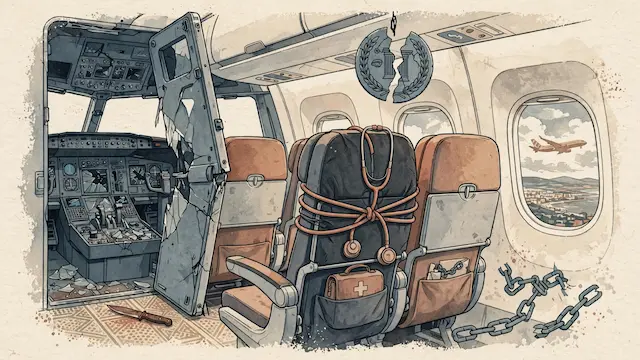
An unusual incident on a Flydubai flight from Dubai to Tel Aviv on September 30, where the first officer allegedly attacked the captain, causing the plane to dive sharply, has brought renewed attention to cockpit security. Passengers reportedly entered the cockpit to subdue the assailant, and two off-duty pilots among the passengers helped take control. The aircraft made an emergency landing in Tabuk, Saudi Arabia. This event prompts a look back at how the cockpit door, once a simple partition, became one of the most secure areas on a plane.
In older passenger aircraft, particularly in the mid-20th century, the separation between the cockpit and the passenger cabin was minimal. Some planes had only a light partition or a curtain, with little distance between passengers and pilots. The cockpit was not considered a fortress requiring defense against intrusion.
Even when doors were present, their primary function was for privacy and to help pilots concentrate, according to U.S. Federal Aviation Administration (FAA) documents. The perception of cockpit doors changed drastically after the September 11, 2001 attacks. New, reinforced doors capable of withstanding forced entry became mandatory. New standards were established in the U.S. in early 2002, with reinforced doors required on relevant aircraft by April 2003.
Beyond the cockpit door, the entire flying experience has become less relaxed. Smoking was once commonplace on flights, with designated smoking areas and ashtrays. Smoking was gradually banned on U.S. flights, starting with short domestic routes in 1988 and eventually extending to all domestic and international flights by 2000. Despite the smoking ban, U.S. aviation regulations still mandate functional ashtrays in lavatories, as a safety measure in case passengers violate the ban.
Over decades, the airplane has transformed from a relatively open space where smoking was permitted and pilots felt close to passengers, into a highly secure environment with reinforced cockpit doors, restricted access, and security integrated into aircraft design.
Mentioned
The same event, reported separately by each outlet. Open a few to compare what different newsrooms emphasize — and what they leave out.
Centre 1Haredi 1

Not the same event — other stories that share this one’s people, places, or theme: background, reactions, and follow-ups.




