
Israeli Election Threshold: Understanding the Real Risk for Small Parties
Translated & summarized from Maariv by baba
The story in 5 lines · by baba
- Voters risk wasting votes on parties near Israel's electoral threshold.
- The number of votes needed to pass the threshold depends on turnout.
- Polls can be misleading for parties polling close to the threshold.
- Parties polling six seats or fewer are considered at risk.
- US midterm elections and their impact on US-Israel relations are briefly discussed.
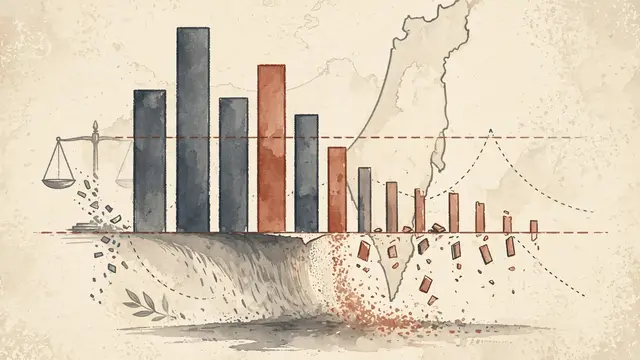
The article discusses the electoral threshold in Israel, emphasizing that the debate should not focus on whether the threshold is too high or too low, but rather on the significant risk voters take when casting ballots for parties close to or below this threshold. In the 2015 elections, nearly 190,000 votes, equivalent to about five Knesset seats, were wasted on parties that did not pass the 3.25% threshold. While some elections see fewer wasted votes, others, like April 2019 and 2022, saw as many as 10 and 4 Knesset seats worth of votes, respectively, go uncounted. This phenomenon occurs when parties are close to the threshold and voters are willing to take a risk, either due to genuine support, optimism, or a misunderstanding of the actual risk involved.
The author argues that parties polling at or below an average of six Knesset seats are at risk. For instance, in the 2022 elections, over 6.8 million eligible voters participated, with a turnout of over 70%. This required approximately 154,855 votes to cross the threshold. The number of votes needed fluctuates based on the total number of eligible voters and the election day turnout. For the projected 2026 elections, with an estimated 7.33 million eligible voters and a 70% turnout, around 166,000 votes would be needed. Higher turnout, such as 75% or 80%, would increase this number significantly to approximately 178,000 or 189,000 votes, respectively.
Polls can be misleading, especially for parties close to the threshold. A party polling at 5 seats, for example, might have a margin of error that places its actual support as low as 3%, meaning it would not pass the threshold. This risk is compounded by potential inaccuracies in predicting voter turnout. The article stresses that polls indicating 4 or 5 seats for a party should be interpreted as a warning that the party is in danger of not crossing the threshold, rather than a guarantee of success.
The piece also briefly touches upon the US midterm elections, noting their proximity to Israel's elections and their potential significance for US-Israel relations. It highlights the candidacy of Abdul El-Sayed in Michigan, whose strong criticisms of Israel, including accusations of genocide, have caused concern among some Jewish voters and pro-Israel groups. The article contrasts El-Sayed's views with different factions within the Democratic Party regarding Israel, suggesting that while progressive voices critical of Israel are growing, they are unlikely to dictate overall US policy towards the country in the immediate future.
Read the original at Maariv