
Germany's Jewish Community Faces "New Middle Ages" Amidst State-Sanctioned Security
Translated & summarized from Channel 9 by baba
The story in 5 lines · by baba
- Jews in Germany feel unsafe, leading to self-censorship and emigration.
- State security measures for Jews are extensive but confined to protected areas.
- Societal rejection of Jewish practice contrasts with state guarantees of freedom.
- The situation is compared to the "Middle Ages" rather than the Nazi era.
- This trend creates a "map of unequal freedom" within Germany.
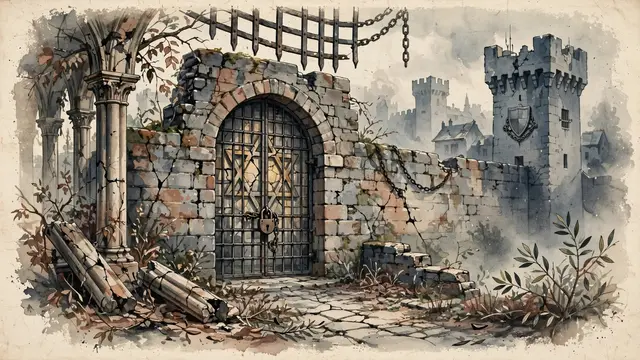
An article published in the German magazine The European argues that the current situation for Jews in Germany, and Western Europe more broadly, is not a repeat of 1932 but rather a new form of the "Middle Ages." The author observes that while the German state guarantees religious freedom, its ability to protect its Jewish citizens is increasingly confined to heavily secured "islands of safety." This is evidenced by the commonplace sight of police cars outside synagogues, concrete barriers, and security cameras, which have become so normalized that many Germans no longer notice them.
Jewish individuals in Germany report feeling compelled to conceal religious symbols like the kippah or Star of David necklace and to avoid speaking Hebrew in public. Some Israelis have reportedly canceled trips to Germany due to safety concerns, and European Jews are emigrating to Israel, describing their daily lives in Germany as precarious. The author contrasts this with the Nazi era, noting that even the criminal Nazi state maintained a monopoly on violence and order, as seen in the swift, albeit lenient, prosecution of soldiers involved in a 1939 massacre of Jews. In contrast, the current situation is characterized by a disconnect between state law and the reality on the street.
The article draws a parallel to the year 1096 during the First Crusade, when mobs and crusaders attacked Jewish communities in German cities like Speyer, Worms, and Mainz. In some instances, authorities attempted to protect Jews, but their efforts were overwhelmed by popular violence, leading to mass killings and forced conversions. This historical event illustrates a time when state authority was not absolute and could be overridden by popular will.
The author posits that contemporary Germany, despite its highly regulated and organized society, is experiencing a similar erosion of state authority in practice. While the state vocally supports the right of Jews to practice their religion freely and provides extensive security measures, the "German street" is perceived as rejecting this, leading Jewish individuals to self-censor. This creates a "map of unequal freedom" within Germany, where the law is uniform but social reality dictates different levels of safety and acceptance depending on location and community affiliation.
This phenomenon is described as a potential "New Middle Ages," a concept theorized by Hedley Bull, characterized not by a return to feudalism but by the fragmentation of state power and the emergence of overlapping authorities and loyalties. The author suggests that this "New Middle Ages" is subtly manifesting in European cities, with its initial impact falling disproportionately on Jewish communities, a trend that historically has eventually affected broader society. The normalization of visible security measures, the author warns, risks making people complacent to larger societal shifts.
Read the original at Channel 9