
Report Details Systemic Antisemitism in US Arts and Publishing
Translated & summarized from Arutz Sheva by baba
The story in 6 lines · by baba
- ADL report reveals systematic antisemitism in U.S. arts and publishing.
- Jewish and Israeli creators face exclusion, silencing, and boycotts.
- Museums show serious deficiencies in Jewish representation.
- Publishing industry suppresses Jewish-themed books and authors.
- Performing artists face protests, cancellations, and harassment.
- Exclusion is not driven by audience demand, survey finds.
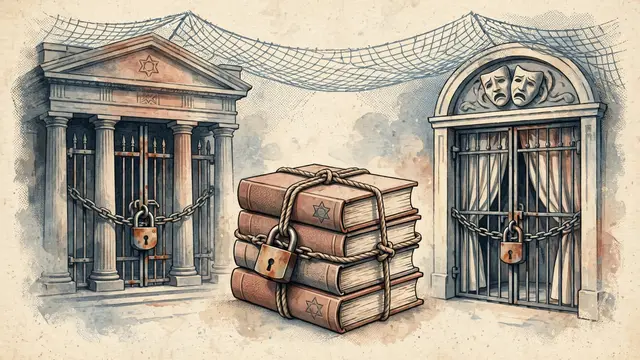
A new report by the Anti-Defamation League (ADL) reveals a pattern of systematic exclusion, radicalization, and silencing of Jewish and Israeli creators, writers, and artists across American museums, the entertainment industry, and publishing houses. The study, the first of its kind, examined antisemitism and the representation of Jews in 40 leading U.S. art museums. Of the museums invited to review and verify their assessments, 23 participated, while the remaining half did not. Twelve museums, including prominent institutions like the Philadelphia Museum of Art and The Broad, received the lowest possible rating, "serious deficiencies." Furthermore, only one museum acknowledged Jewish American Heritage Month in 2026, despite 60% actively celebrating other heritage months during the same period. Many museums hold significant Jewish and Israeli collections, but these works are often integrated into broader narratives, obscuring their Jewish or Israeli significance, or are difficult to locate online.
In the publishing sector, the report, based on secondary research and over 30 interviews, identifies seven key trends since October 7, 2023. These include the suppression of books with Jewish, Israeli, or Zionist characters or content at the manuscript acquisition stage, blacklisting and boycotts of authors and Israeli publishing houses, and a 2024 letter signed by over 1,000 authors calling for a boycott of Israeli publishers. Other trends noted are exclusion from literary events and festivals, "review bombing" with negative online ratings before books are even read, and difficulties in finding literary agents. Some authors reported being told their Jewish or Zionist identity made them "too risky" to represent. The report also highlights institutional silence and a lack of direct engagement with antisemitism from professional bodies. Author and photographer Elissa R. Rosenhak commented, "This is what literary antisemitism looks like. It doesn't appear with swastikas. It hides behind excuses, shifting standards, institutional silence, community exclusion, and decisions that are hard to separate from the climate created around Jewish voices after October 7."
In the performing arts, the report documents 65 incidents across 41 venues in the U.S., with the most recent dating to August 2026. According to the ADL, openly Jewish, Israeli, and Zionist artists increasingly face criticism, protests, disruptions, and performance cancellations. Trends include protests against cultural performances, such as repeated demonstrations against artists like Matisyahu, the Batsheva Dance Company, and the Israel Philharmonic Orchestra. Security concerns have also acted as a "security veto," leading to event cancellations due to the potential for protest, as happened with musicians Mikey Pauker and Reviv Kenner. Informal cultural boycotts and institutional distancing are also noted, with Israeli singer Noga Erez describing the loss of international performances due to her Israeli identity. Disruptions and harassment have occurred, including comedian Judy Gold being called "You're a Jew" during performances in April 2026, and singer-songwriter Regina Spektor facing heckling. The report points to an escalation on social media that shortens institutional decision-making processes and institutional inconsistency in responding to public outcry.
Concurrently, the ADL Center for Extremism released an investigation into activist groups pressuring cultural institutions to distance themselves from Jewish and Zionist artists. This trend involves harassment, physical intimidation, vandalism, Holocaust trivialization, support for terrorism, antisemitic stereotyping, organized disruptions, and blacklisting. An accompanying survey indicates that this exclusion is not driven by audience demand, as a large majority of Americans stated they would support the inclusion of Jewish and Israeli creators, though many also said it was "understandable" for others to avoid such works. Shira Goodman, ADL's Vice President of Public Affairs and Special Initiatives, stated, "This research points to a clear and consistent gap between perceived market risk, the messages conveyed to Jewish and Israeli writers, and the actual audience demand." She added that interviews with publishing professionals revealed a recurring pattern where authors are asked by agents and publishers to remove Jewish and/or Israeli themes and characters from their works due to fears of poor sales or being perceived as too risky. The survey findings suggest this risk aversion stems from a misconception and does not reflect market reality, a matter the industry needs to urgently address. Jonathan Greenblatt, ADL's Global CEO, stated, "Jewish artists' performances are being canceled, they are being blacklisted and pushed out of American cultural life. We knew the situation was dire, but not this dire, and no one has documented it like this before. Forty leading museums, and not one of them includes Jewish identity within its diversity, equity, and inclusion (DEI) commitments. Writers are asked to remove Hebrew words and change Jewish character names just to get published. Jewish and Israeli artists are harassed, excluded from performances, and removed from art programs. Simply put, this is antisemitism and discrimination against Israelis. The culture and arts sector must wake up before Jewish voices are silenced completely."
Read the original at Arutz ShevaMentioned
The same event, reported separately by each outlet. Open a few to compare what different newsrooms emphasize — and what they leave out.








Not the same event — other stories that share this one’s people, places, or theme: background, reactions, and follow-ups.
