
50 Years After Entebbe, State Archives Reveal the Decision-Making Behind the Raid
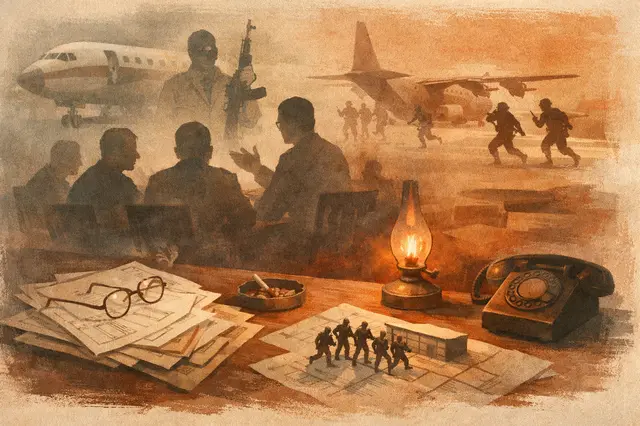
As Israel marked 50 years since the Entebbe operation, the State Archives on Friday released protocols, conversation transcripts and documents that for the first time reconstruct almost hour by hour how the rescue decision was made. The files show the government’s deliberations in the week after an Air France plane, flying from Tel Aviv to Paris, was hijacked on 4 July 1976 by Palestinian militants from the Popular Front and Germans from the Revolutionary Cells. After a brief refueling stop in Libya, the aircraft was forced to land in Entebbe, Uganda, where most foreign passengers were freed and 105 passengers and crew, mostly Israelis and Jews, were held out of about 250 people on board.
During the crisis, Rabin convened 18 meetings of a small special team. He kept opposition leaders informed and met newspaper editors, asking them to act responsibly and avoid publishing details that could endanger the hostages or the rescue effort. The newly released material largely contradicts the claim that negotiations were intended from the outset to deceive the hijackers. Instead, the records show the cabinet seriously considered releasing prisoners as part of a deal, and only later, once a military plan seemed feasible, did talks also become a way to preserve surprise.
The hijackers demanded the release of 53 prisoners described in the article as terrorists and anarchists held in Israel and abroad, plus a cash ransom. They threatened to execute two hostages every hour unless their demands were met by 1 July, then extended the deadline to 4 July after Israel agreed to negotiate. On the day the ultimatum expired, C-130 Hercules aircraft carried IDF commandos about 4,000 kilometers from Israel to Uganda, where they stormed the terminal, killed the hijackers and freed 102 hostages. Three hostages were killed in the operation, along with Lt. Col. Yonatan Netanyahu, the commander of Sayeret Matkal’s assault force.
The documents also detail the planning. The chief of staff briefed ministers on the terminal area, the nearby Ugandan army camp, and the landing plan, saying the force would land at 11:00 p.m. Uganda time and needed to leave as quickly as possible in darkness. He estimated 12 to 10 terrorists and 60 to 50 Ugandan soldiers in the hostage area, with the captors and soldiers armed with pistols and submachine guns. Israeli forces even improvised a Mercedes of the same model as Idi Amin’s, which was the first vehicle to reach the terminal after the landing. Rabin told hostage families, “The government has decided it is prepared to enter negotiations and release prisoners to save the hostages,” while Defense Minister Shimon Peres warned that conceding would mean no country would dare fight terrorism. In the decisive cabinet session, Peres called the raid unprecedented, Rabin warned of significant casualties but recommended approval, and the ministers voted unanimously for the operation.
The same event, reported separately by each outlet. Open a few to compare what different newsrooms emphasize — and what they leave out.







Not the same event — other stories that share this one’s people, places, or theme: background, reactions, and follow-ups.
Ask About This Article
Duki reads it, and every newsroom on the same story, then answers with sources.