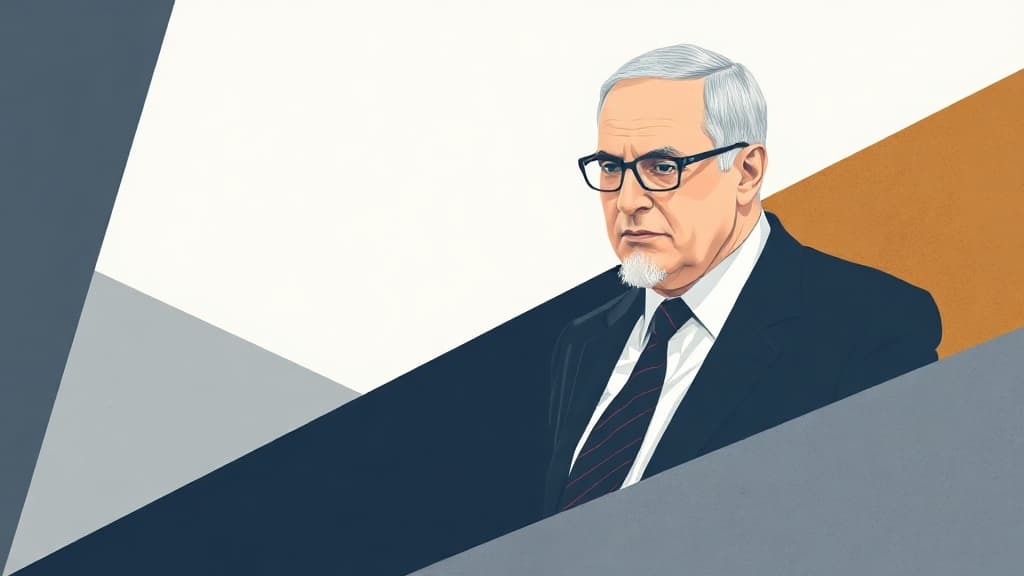
Rafi Ben Shitrit: “Netanyahu Hasn’t Called Me Since October 7, He Forgot What It Means to Be Human”

Rafi Ben Shitrit, the former mayor of Beit She’an, was interviewed today, Sunday, on “Sari and Schlesinger,” ahead of his planned inclusion on the Yisrael Beiteinu slate in the upcoming elections. Ben Shitrit, once one of Likud’s senior figures and the head of Netanyahu’s campaign headquarters in Beit She’an, who lost his son Elroei in the battle at Nahal Oz on October 7, voiced deep disappointment and complete loss of trust in his former party and launched an unusually harsh attack on the country’s leadership and its head.
Ben Shitrit recounted the moments of the disaster: “On October 7 I woke up from a nightmare that terrorists were shooting at me, exactly at 7:52 in the morning. When we learned that Elroei was in Nahal Oz, I ran home from synagogue. At 9:40 a terrorist answered his phone and screamed ‘Allahu Akbar’ in the middle of gunfire and screams. Our world was shattered. We were between hope and despair until Wednesday at dawn, when they knocked on the door and told us he had fallen in battle. Elroei was the jewel in the crown, a child made of heart, love and talent, and the void is enormous. This longing is a 200-ton stone on my shoulders.”
“I carry with me immense pain that does not let up,” he said. “But there is pain that does not leave me and gives me the strength to get up and fight, and that is the pain of the abandonment, the turning away, and the betrayal by the state and the government. The coalition of the October 7 massacre is out of the question for me. Everyone out. Five years, ten years, fifteen years, sit in the opposition. Otzma Yehudit, Shas, United Torah Judaism, Likud and Religious Zionism, supposedly Religious Zionism. You failed, you neglected, you committed a crime, out. Take responsibility, for God’s sake. This happened on your watch, you sat in the cockpit and led to total collapse. Is this the government I voted for? Is this a right-wing national government? Instead of looking in the mirror they blame the attorney general, the military advocate general, Ehud Barak and Obama.”
Ben Shitrit revealed that since the grave disaster, Prime Minister Benjamin Netanyahu, whom he knew and with whom he worked closely for decades as his chief of staff, had not contacted him at all. “Netanyahu didn’t call. Nothing,” he said in visible disappointment. “He once said, ‘The left have forgotten what it means to be Jews,’ but he himself forgot what it means to be human. Anyone who has nothing to hide is not afraid of an investigation. This man is the father of the entire concept, he is the one who fostered the terrible reality of containment toward Hamas and knowingly approved Qatari money transfers.”
In contrast to Netanyahu, Ben Shitrit spoke favorably of Cabinet minister Gideon Sa’ar, who had personally accompanied him, but made clear that he had rejected Sa’ar’s offer to return to Likud: “The Likud of today is not the Likud I know. There they put the king before the kingdom, and I’m not there.”
Ben Shitrit described his tense meetings with the senior security establishment after the massacre: “Chief of Staff Herzi Halevi met with me four times one-on-one. I said very harsh things to him. I did not believe that I, a reserve major, was speaking like that to a lieutenant general, but I said everything. I asked him what kind of twisted thing this was, that when combat soldiers come under fire they run to shelters instead of running to positions and shooting at anything approaching the fence? I asked to know what he did from the moment the signs began at 3:00 in the morning, and he laid out for me minute by minute his conversations with the division commander and the regional commander. He looked me in the eye and said: ‘We did not imagine an attack of this scale.’ Ronen Bar also came to my home in Beit She’an, I sat with him one-on-one and saw the attempts to explain and to hurt with us.”
In a conversation about the behind-the-scenes process of entering politics, Ben Shitrit revealed that he met with a number of leaders, including Gantz, Lapid, Hendel, Bennett and Eisenkot, but explained why he ultimately chose Liberman and not a partnership with former chief of staff Gadi Eisenkot, despite their natural closeness: “I sat with Eisenkot and was deeply impressed. First of all, he is a bereaved father, a chief of staff, Golani, Mizrahi, Moroccan, there is the strongest connection between us. But honestly, I was not impressed that at this time, in this era, he could truly lead the struggle against Netanyahu. We have already seen chiefs of staff like Ehud Barak and Benny Gantz land straight in politics and fail. You need a rich political background and experience.”
“I didn’t go political shopping, and no one offered me a concrete place before that,” he clarified. “With Liberman I identified truth, sincerity and willingness. He has held a long list of positions and he is the most suitable person. Beyond that, Liberman opened the ranks to new sectors and turned the party into a distinctly Israeli mosaic that resembles the beautiful Likud we grew up on.”
Ben Shitrit, one of the founders of the October Council, confirmed that he will be placed in a realistic spot on the Yisrael Beiteinu slate and set an uncompromising red line for any future coalition: “The main mission is to establish a state commission of inquiry as defined by law, headed by a Supreme Court justice, with its composition determined by the president of the Supreme Court, Yitzhak Amit. Nothing else will be acceptable to us. The commission must investigate everyone and everything, going back 20 years, political, military and security levels, with no concessions to anyone, including previous governments, defense ministers and chiefs of staff. We owe this to justice for the fallen, to the families’ closure, and to responsibility for future generations.”
He expressed concern that nearly three years have passed since the massacre and no commission of inquiry has yet been established: “There is a fear of evidence being concealed, documents being shredded, and people also naturally forgetting. In the end, it has to be investigated very, very deeply. There is no other way, to investigate in a way that is not biased and is not subject to some political whims.”
Asked why Netanyahu fears such a committee, Ben Shitrit replied: “As the son of an important historian, he cares very much what history will write about him, and what historians will say about the October 7 massacre. It is convenient for him to refer only to the tactical achievements that came afterward, successes have many fathers and failure is an orphan. He explicitly said: ‘Let’s talk about October 8 and onward.’ What happened before does not interest him.”
He clarified that he will not sit in a future government with Smotrich and Ben Gvir because of their responsibility for the October 7 cabinet, but noted that the party would not rule out a partnership with parts of Likud who agree to split off, oust Netanyahu and accept the basic guidelines of the Zionist government. He also completely ruled out sitting in a government with Mansour Abbas: “October 7 completely changed perceptions. There will be no Mansour Abbas, we will go to elections five times if necessary and remain in a transitional government, but we will only establish a Zionist government of a service-minded alliance.”
On religion and state issues, Ben Shitrit laid out a liberal-traditional line: “I belong to traditional Zionism and the line is live and let live. In a city like Beit She’an, with a conservative orientation and 120 synagogues, there will be no public transportation on Shabbat, but in liberal cities, each local authority head will decide according to his city council. The same goes for civil unions, let people decide their own lives.”