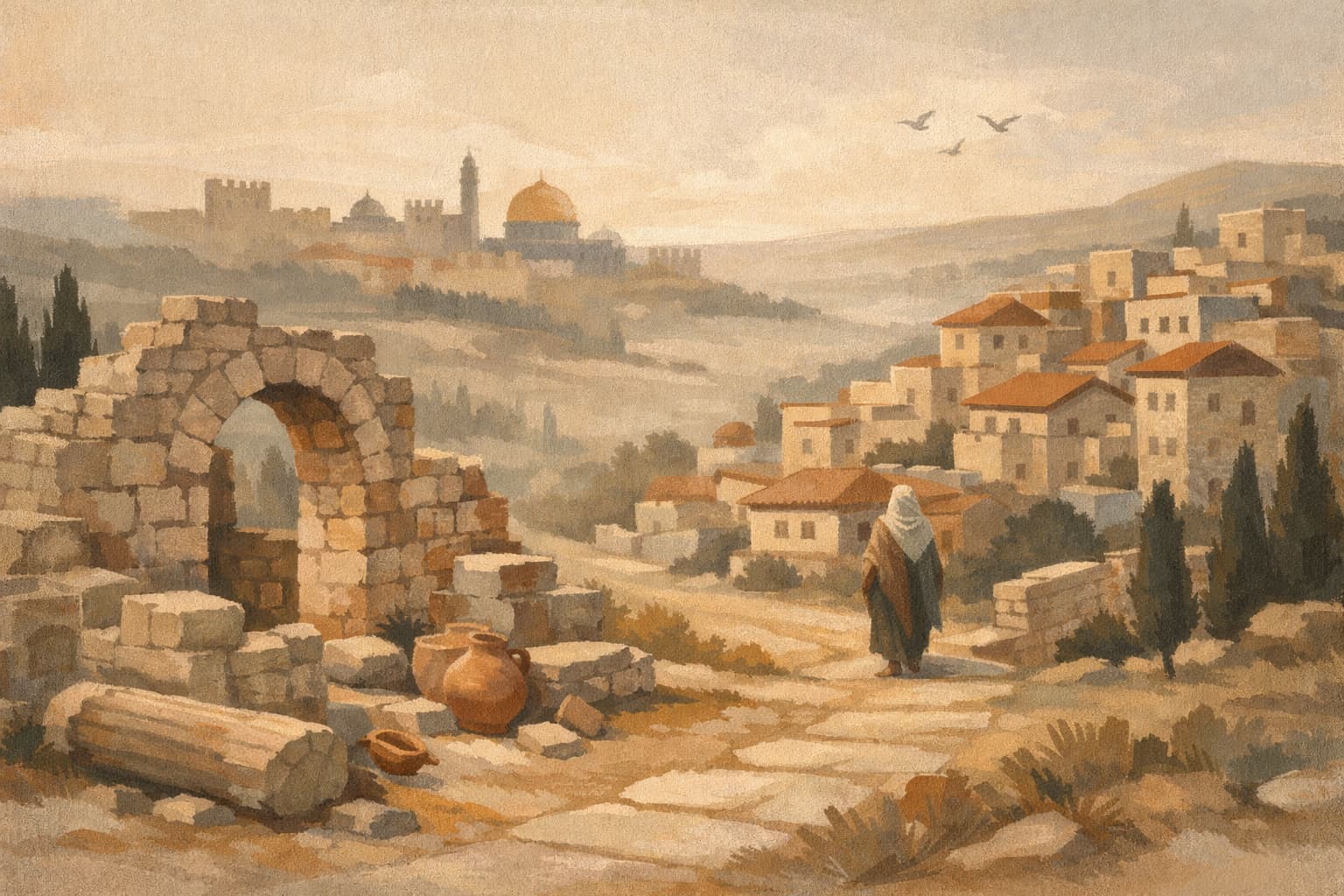
Nevé Yaakov Marks 102 Years Since Its Founding as the “Second Jerusalem”

This week, on the 8th of Tammuz 5786, Neve Yaakov marked 102 years since it was founded as a “Hebrew village.” The settlement began in the summer of 1924, when members of the Young Mizrachi movement organized under the Nahalat Bayit association to establish a new colony north of Jerusalem.
Among the founders and movement leaders were Rabbi Yitzhak Avigdor Ornstein, who lived there until 1940, Rabbi Yitzhak Yaakov Wachtfogel, the head of the Maoz Shaarim yeshiva, and also Dov Natan Brinker and Avraham Leibel, who purchased the land. The article notes that in Neve Yaakov there is a small antiquities site, Khirbet Dir al-Salam, which Dr. Yossi Shpiener, in his book “Uri Tzafon B,” suggests identifying with the “northern Jerusalem” mentioned in the Talmud.
Shpiener cites Tractate Arakhin, where Rav Ashi says, “there were indeed two Jerusalems,” to resolve a contradiction about Jerusalem’s sanctity and walled-city laws. He also points to a geographic-historical explanation in Midrash Tadshe, which describes Jerusalem as two towns, an upper one associated with Judah and a lower one with Benjamin, later joined by King David into one city.
The article adds that Tractate Eruvin uses Jerusalem as a geographic marker when discussing the city’s boundaries. Khirbet Dir al-Salam has remains of a Second Temple period village and burial caves from the late Temple era, and its name is read as a clue to “Salam,” meaning Jerusalem. Neve Yaakov was formally founded in 1925, was destroyed and abandoned in the War of Independence after a prolonged siege and heavy fighting, and was re-established only in summer 1970 after the Six-Day War as part of Jerusalem’s ring neighborhoods. Today it has more than 30,000 residents.

