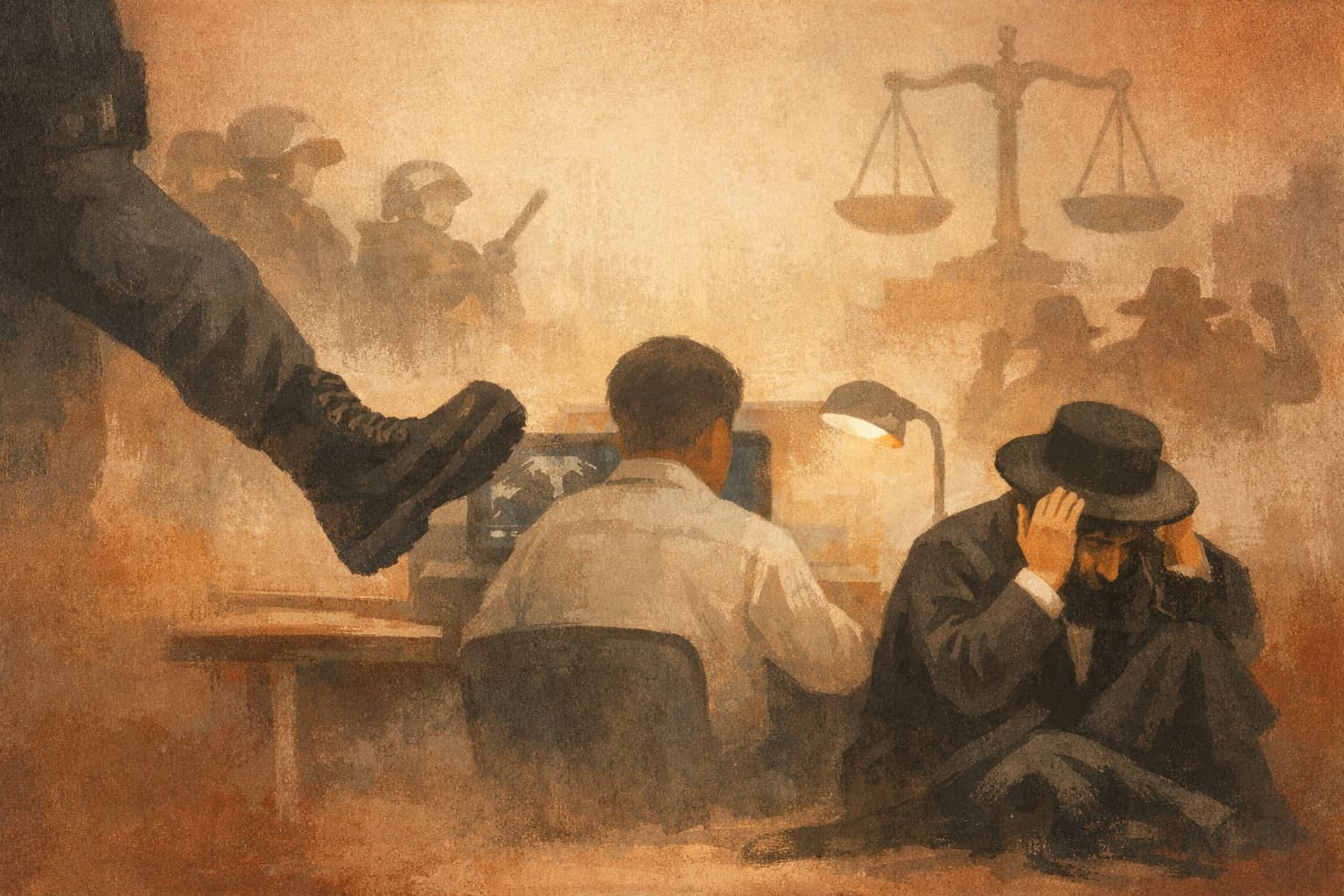
Police officer who kicked Haredi protester’s head questioned and released

The officer seen kicking the head of a Haredi protester about a week ago was questioned on Thursday by Israel’s Police Internal Investigations Department and released without restrictions. At the same time, investigators reviewed another video showing the commander of the Ramat Gan-Bnei Brak station dragging a protester and tearing his clothes, and concluded there was no suspicion of an offense.
The Internal Investigations Department opened its probe last Wednesday after videos from Haredi protests in Bnei Brak showed police beating demonstrators. The protests were led by thousands of ultra-Orthodox extremists known as the “Hatzfanikim,” part of the Jerusalem Faction, who blocked the entrance to Prison 10 in protest over the jailing of draft evaders arrested by the military police.
National Security Minister Itamar Ben Gvir told the police chief he was considering using his authority to fire or permanently remove officers who acted violently and unlawfully during last week’s Haredi protests. Despite that, Police Commissioner Danny Levy issued a statement backing the Bnei Brak station commander and the district commander.
In the police statement, Levy said he spoke with the district commander and station commander, heard their account, and accepted their position that in a serious incident in which a major road was blocked early in the morning, disrupting public order and the daily lives of tens of thousands of citizens, “significant police action” was needed to restore order. The statement added that Levy expressed “his appreciation and support” for commanders and officers in the field.
Meanwhile, extremists from Haredi factions have continued large protests and traffic disruptions across Israel in recent weeks over arrests of draft evaders. A protest held on Wednesday night saw motorcades depart from 19 locations nationwide toward Prison 10, causing heavy congestion on major routes even though the convoys did not reach their destination near Beit Lid. MK Goldknopf, who took part, said, “We will continue the protests until the arrests stop completely.”
The same event, reported separately by each outlet. Open a few to compare what different newsrooms emphasize — and what they leave out.


Not the same event — other stories that share this one’s people, places, or theme: background, reactions, and follow-ups.


