
Fresh Paint Fair Spotlights Textile, Metal, and War-Tinged Works
Translated & summarized from Calcalist by baba
Fresh Paint opened its 17th edition today in Tel Aviv and will run until next Monday at 7 Kramnitski Street. The fair showcases hundreds of artists and designers, with standout works in textiles, jewelry, sculpture, and paper that blur art and design. Several pieces respond directly to October 7, the hostage campaign, and Israel’s current security mood.
The story in 5 lines · by baba
- Fresh Paint opened its 17th edition today in Tel Aviv.
- The fair runs until next Monday at 7 Kramnitski Street.
- Hundreds of artists and designers are shown across art and design sections.
- Works reflect October 7, the hostage campaign, and Israel’s security anxiety.
- Highlights include textile, jewelry, and paper works that blur art and design.
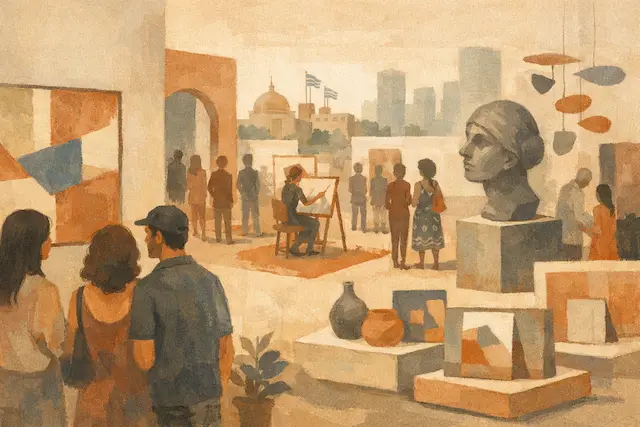
Israel’s largest commercial art fair, Fresh Paint, opened for its 17th edition today in Tel Aviv and will be open to the public from now until next Monday at 7 Kramnitski Street. The fair is led by Sharon Tillinger and Yifat Gurion, sponsored by Harel and Zurich Insurance Group, and again brings together hundreds of artists, designers, and creators across commercial galleries, a young artists’ incubator, and a fresh design section.
This year’s edition features craft and design techniques of many kinds, including sewing and textiles, stained glass, jewelry, sculpture, relief, and paper works. The article says the fair stands out for precise, labor-intensive, almost obsessive works in unusual materials, reviving interest in matter and old and new technologies in the digital age while blurring the line between art and design.
Among the highlights is a focused exhibition by Miriam Cabessa, one of Israel’s leading abstract painters. Other notable works include Zvia Green’s textile pieces in the Corridor Gallery, made with fiber techniques and Japanese paper-weaving methods, and Simcha Even-Chen’s ceramic sculptures, which resemble jelly candies but are built around the Möbius strip, a mathematically inspired endless loop. Painter Liran Verdial also explores materiality through realistic scenes that look as if they were folded from paper, with themes of loneliness and relationships and an evident nod to the late David Hockney.
In the young artists’ incubator, Gafen Berkel, a survivor of October 7 from Kibbutz Gevulot in the Gaza border area, shows tiny jewelry-like objects shaped like bombed and ruined houses, created as memorials to the massacre. Opposite her are realist portraits by Celia Cohen of the Israeli women who led the public campaign to bring home the hostages and end the war, including Einav Zangauker, who has become a symbol of the struggle.
The fresh design area also reflects current Israeli life. Shaul Cohen’s “Souvenir Shop for a Country Without Tourists” presents ironic and nostalgic objects, from miniature Tempo and Tnuva crates to Byzantine mosaics with Adidas-clad figures taking selfies, personal alcohol bottles styled like old foam coolers, and a lamp modeled on the old lighthouse at Tel Aviv port. Eden Ohan’s home objects add surreal, humorous touches, especially smiley plates that switch between happy and sad through holograms, while Tamar Nix’s “Barbed Wire Knit” uses a soft, colorful form to evoke danger, threat, and the unstable security reality.
Mentioned
The same event, reported separately by each outlet. Open a few to compare what different newsrooms emphasize — and what they leave out.
Other 2
